Owens Valley Radio Observatory Long Wavelength Array

Observing Status

Array status and latest spectrograms/images.

Direct Me

OVRO-LWA Data

Browsing and using OVRO-LWA data products.

Direct Me

Data Analysis

OVRO-LWA imaging and analysis tutorials.

Direct Me

GitHub Repository

OVRO-LWA solar data processing pipeline.

Direct Me

Frequency range

13.4 – 86.9 MHz

Field of View

Full Sky (beamformed) / Wide Field (imaging)

Bandwidth

73.5 MHz instantaneous (13.4-86.9 MHz)

Frequency resolution

Raw: 24 kHz (3072 channels, 13.4-86.9 MHz)
Level 1 spectrograms: 96 kHz
Fast mode: 96 kHz (768 channels)
Level 1 images: 384 kHz (fine-channel) or 4.6 MHz (band-averaged)

Time resolution

Raw beamformer: 1 ms (capable), 64 ms (regular)
Level 1 spectrograms: 256 ms
Slow visibility: 10 s
Fast visibility: 0.1 s (100 ms)
Level 1 images: 10 s integration, 20-60 s cadence

Polarization

Full Stokes (IQUV) - currently Level 1 products provide Stokes I only

Number of antennas

352 dipole antennas total
256 antennas in core (beamformer)
48 antennas (fast visibility mode)

Antenna type

Crossed-dipole antennas (fixed position)

Operating modes

Beamformer: 256 core antennas, 3072 channels, 24 kHz resolution
Slow visibility: All 352 antennas, 3072 frequencies, 10 s cadence
Fast visibility: 48 outer antennas, 768 frequencies, 0.1 s cadence

Angular resolution

Beamformer: >1° synthesized beam
Imaging: Dynamic range >300, resolution depends on baseline distribution

Array size

Distributed array, ~1.5 km maximum baseline

Data format

Raw: HDF (spectrograms), CASA .ms (visibilities)
Level 1: FITS (spectrograms), HDF (images)

Observing constraints

Solar elevation >15° (7-14 hours/day depending on season)


Distributed Array Layout: The OVRO-LWA consists of 352 crossed-dipole antennas distributed across the Owens Valley Radio Observatory site. The array includes 256 antennas in the core region that are used for beamforming operations, providing high-sensitivity total-power spectrograms of the Sun. The remaining antennas extend the array to provide longer baselines for improved angular resolution in interferometric imaging modes. The distributed configuration yields excellent uv coverage for snapshot imaging, enabling high-quality images of solar radio sources without requiring Earth-rotation synthesis.


Array Characteristics: The array has a maximum baseline of approximately 1.5 km, providing a good balance between angular resolution and sensitivity. The dense core region ensures high sensitivity for detecting weak solar radio emissions, while the extended baselines improve resolution for detailed imaging of solar features. The fixed antenna positions eliminate the need for complex tracking systems and allow for continuous, uninterrupted observations of the Sun when it is above the horizon and at elevations greater than 15 degrees.
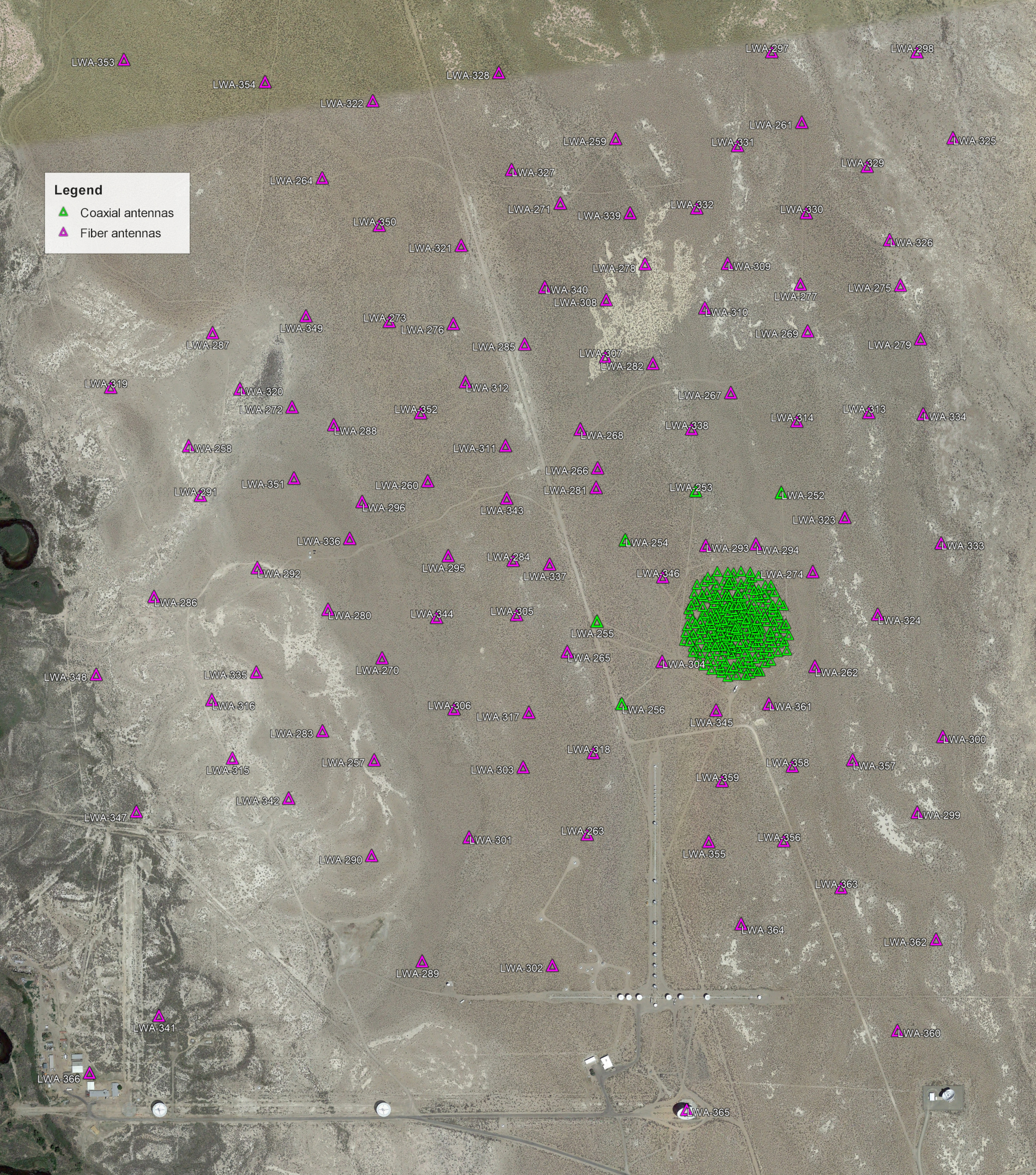
 

OVRO-LWA Antenna Layout

Layout of the 352 OVRO-LWA antennas showing the distributed array configuration across the Owens Valley site.


Operations of OVRO-LWA are supported by the National Science Foundation under grant No. AGS-2436999. Additional support is provided by NASA under grant No. 80NSSC20K0026. Any opinions, findings, and conclusions or recommendations expressed in this material are those of the author(s) and do not necessarily reflect the views of the National Science Foundation and NASA.