Parker Solar Probe Encounter 29 — OVSA Campaign
Background
The Owens Valley Solar Arrays (OVSA) supported Parker Solar Probe’s 29th perihelion encounter with coordinated solar radio observations during 2026 September 2–13, surrounding perihelion on September 4. This page collects selected events observed by the Expanded Owens Valley Solar Array (EOVSA, 1–18 GHz) and the Owens Valley Radio Observatory Long Wavelength Array (OVRO-LWA, 13.4–86.9 MHz), together with spectrograms, spectral imaging movies, and links to the available fully calibrated, science-ready data.
Parker Solar Probe Campaign Support
This PSP perihelion observing campaign and the preparation of its supporting data products are supported by NASA’s PSP Data Support award 80NSSC26K1200.
Suggested acknowledgement for publications
This work used observations from the Owens Valley Solar Arrays obtained during the Parker Solar Probe Encounter 29 campaign. The observing campaign and preparation of its supporting data products were supported by NASA’s Parker Solar Probe Data Support award 80NSSC26K1200.
EOVSA was designed, built, and is now operated by the New Jersey Institute of Technology (NJIT) as a community facility. The OVRO-LWA expansion project was supported by NSF under grant AST-1828784. EOVSA and OVRO-LWA solar operations are supported by NSF grant AGS-2436999 to NJIT.
Please follow the OVSA Data Policy for additional citation and authorship guidance, including crediting those who collected, processed, and curated the data. Please reach out to OVSA PI Bin Chen if you have any questions or need assistance.
Quick guide to the products
| Date and time (UT) | Event description | EOVSA spectrogram | EOVSA spectral images | OVRO-LWA spectrogram | OVRO-LWA spectral images | Spacecraft & event geometry | Credit |
|---|---|---|---|---|---|---|---|
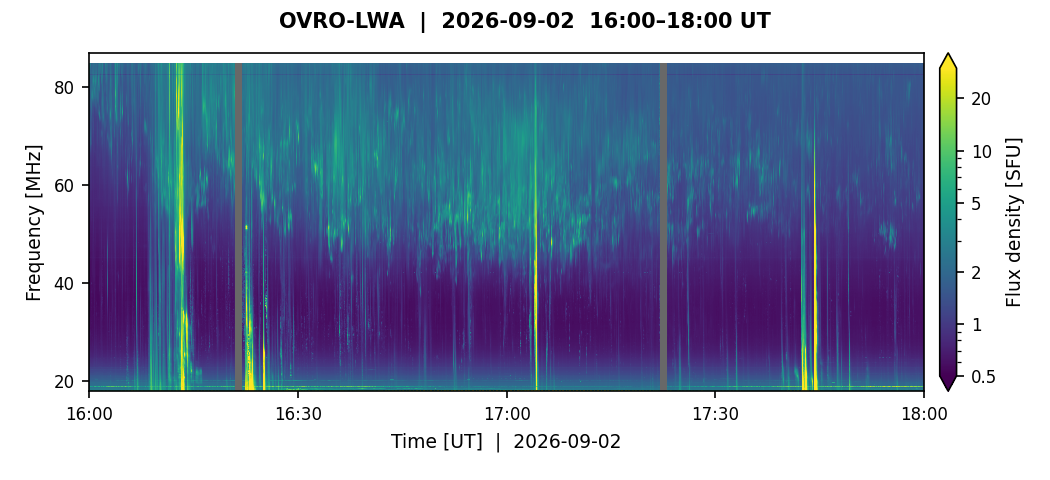
2026 Sep 02 | A GOES C1.5-class flare. EOVSA observed two weak microwave bursts corresponding to this flare. OVRO-LWA observed corresponding type III radio bursts, although the timing overlaps with a type IV radio burst off of the same limb. AIA imaging shows that it is associated with a confined flare. |  Cross-power preview · Download FITS data: Cross-power (1.1–18.0 GHz; Sampling: 1.0 s, 0.011–0.041 GHz within bands) | N/A (weak or no microwave signal) |
|  Stokes I spectral-image preview (16:23:01 UT) · Play movie · Download fine-channel HDF5 data (18.17–86.70 MHz; Typical cadence: ≈20–30 s; 180 spectral channels at 0.383 MHz resolution; 10 s integrations) | 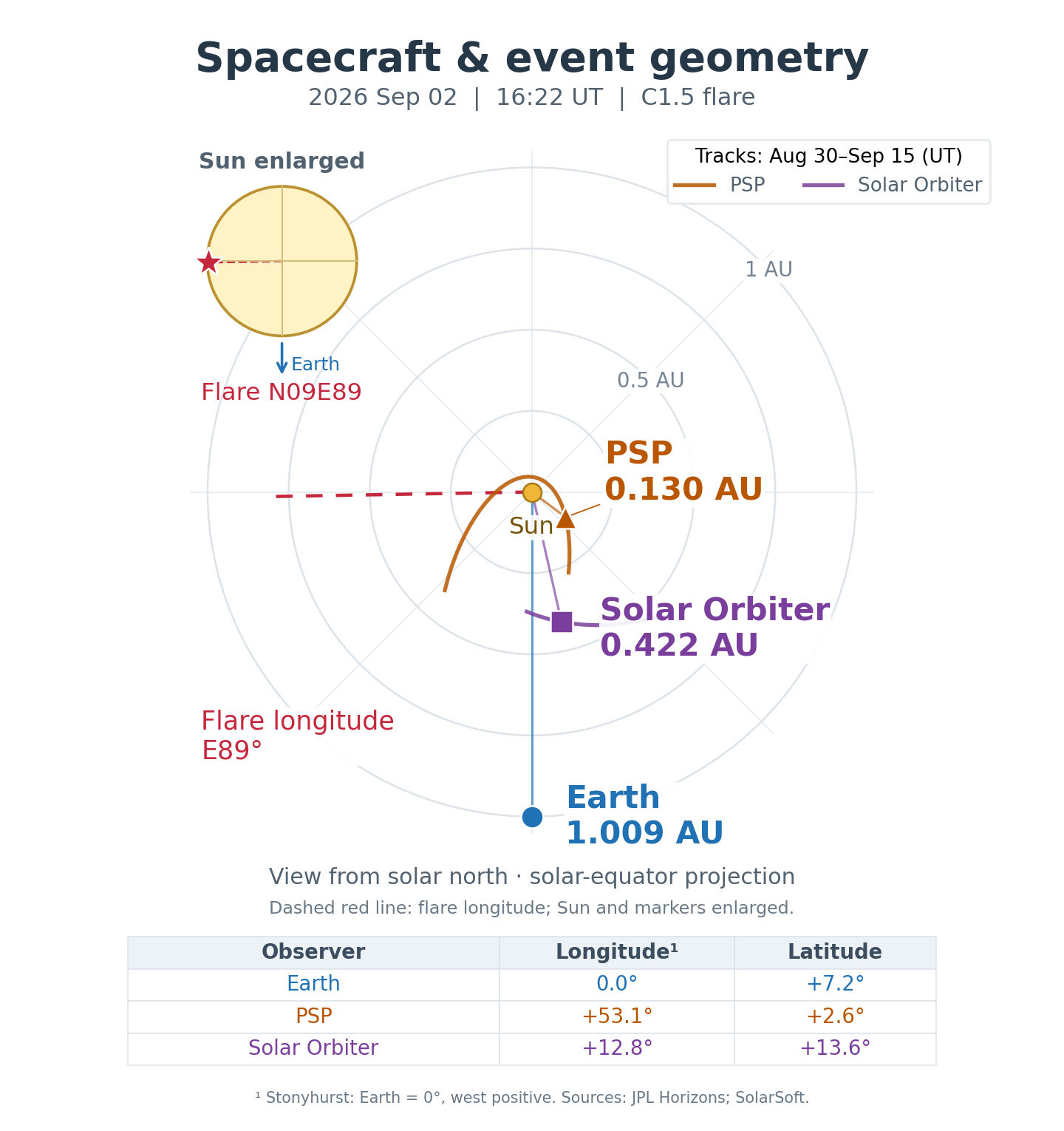 Geometry at 16:22 UT. C1.5 flare at N09E89. Solar-north view; spacecraft positions projected onto the solar equator. Inset: enlarged Sun. Full-size plot · Positions: JPL Horizons; Flare: SolarSoft. | EOVSA: Meiqi Wang |
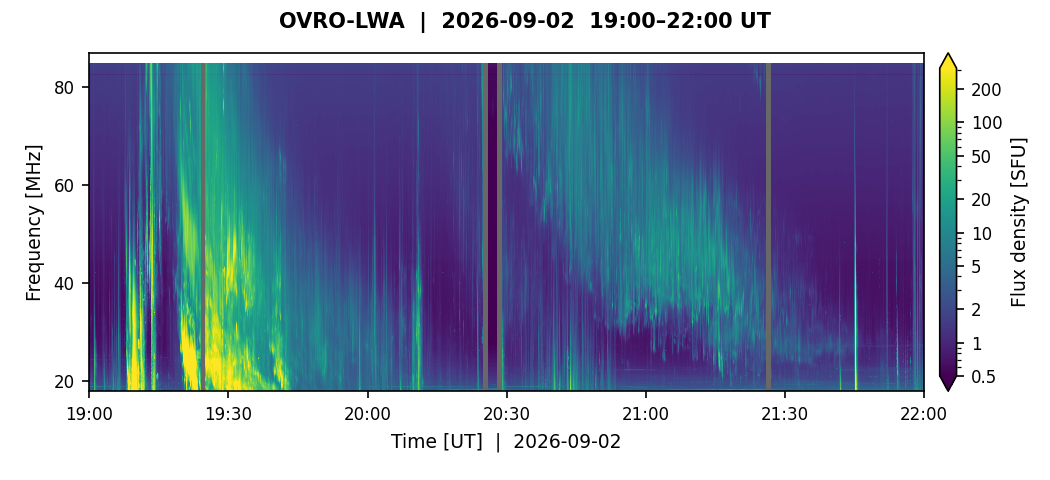
2026 Sep 02 | A gradual M3.0-class flare near the east limb (N12E88) was accompanied by a halo CME. EOVSA observed broadband microwave bursts associated with the flare. OVRO-LWA detected multiple type III bursts during the flare onset, followed by type II emission and a negatively polarized type IV continuum. |  Cross-power preview · Download FITS data: Total-power · Cross-power (1.1–18.0 GHz; Sampling: 1.0 s, 0.011–0.041 GHz within bands) | 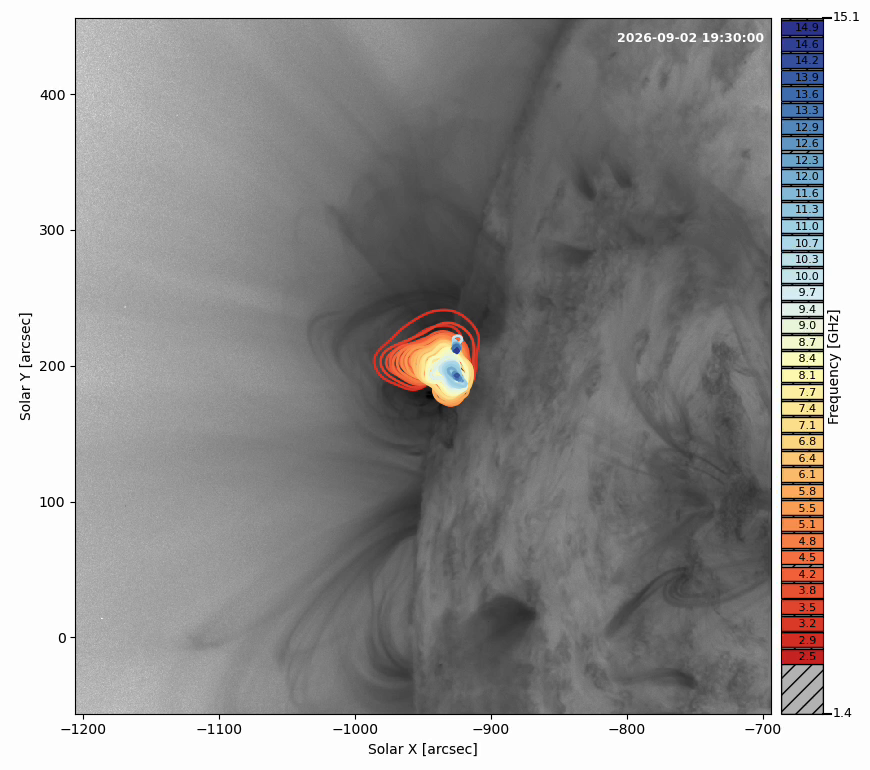 Spectral-image preview · Play movie · Download FITS data (2.55–14.89 GHz; Sampling: 4 s, 39 spectral channels at ≈0.325 GHz spacing) Antennas used for imaging: 1, 3, 4, 5, 6, 8, 9, 10. |
| 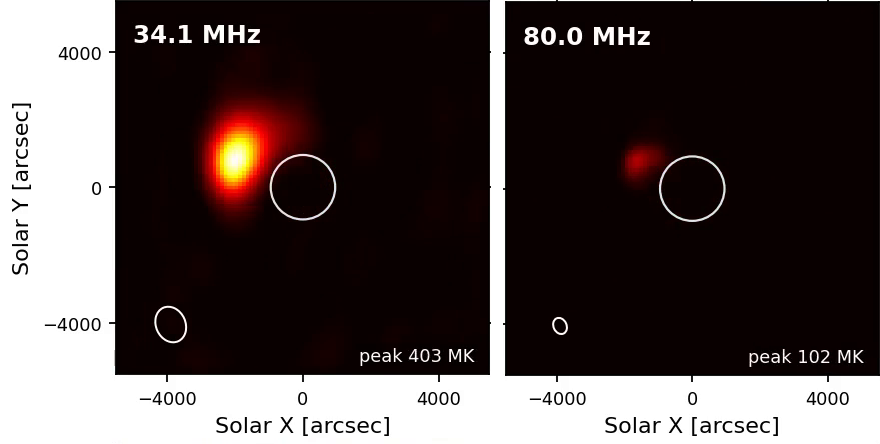 Stokes I spectral-image preview (19:20:04 UT) · Play movie · Download fine-channel HDF5 data (18.17–86.70 MHz; Typical cadence: ≈20–30 s; 180 spectral channels at 0.383 MHz resolution; 10 s integrations) | 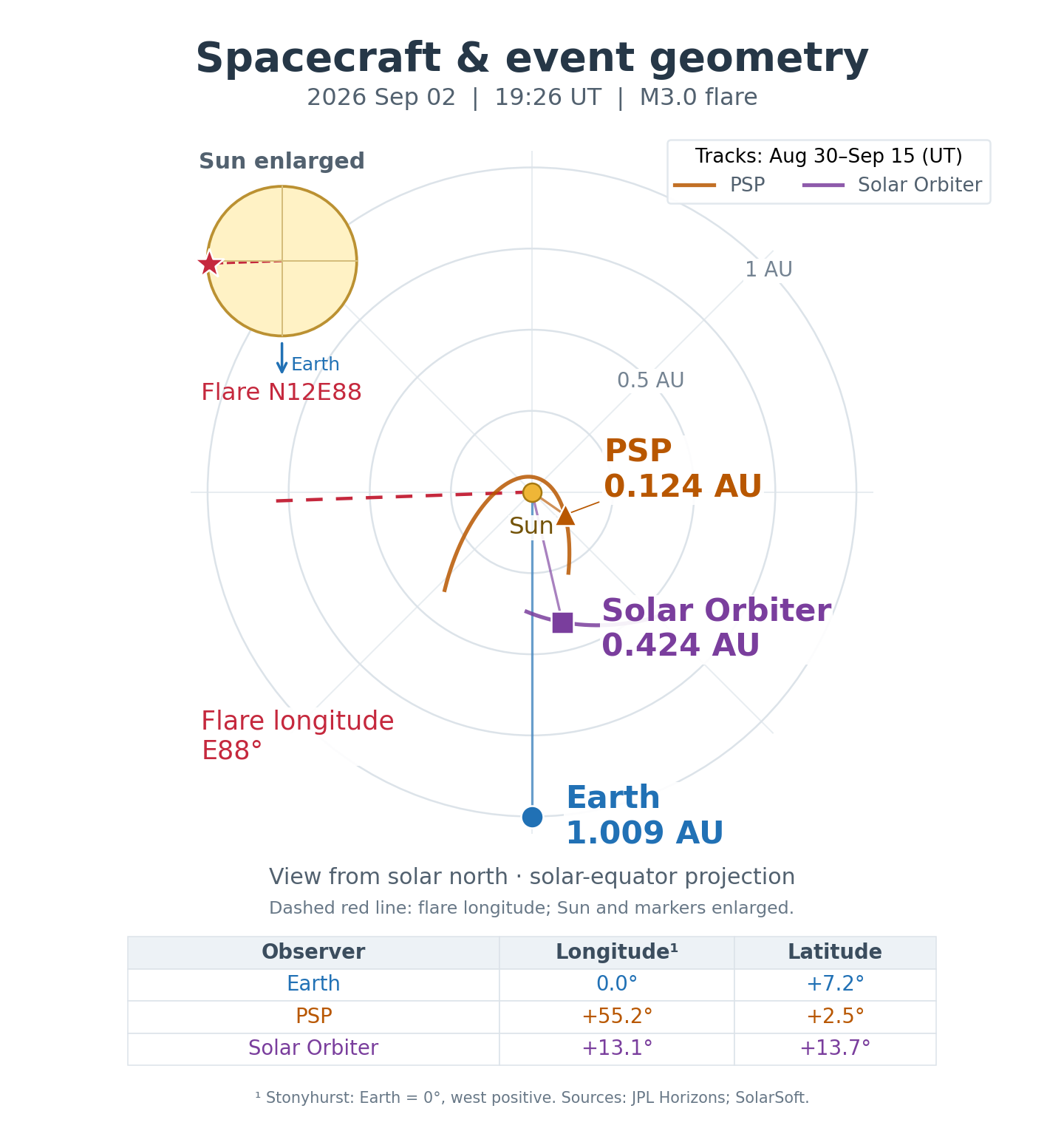 Geometry at 19:26 UT. M3.0 flare at N12E88. Solar-north view; spacecraft positions projected onto the solar equator. Inset: enlarged Sun. Full-size plot · Positions: JPL Horizons; Flare: SolarSoft. | EOVSA: Meiqi Wang |
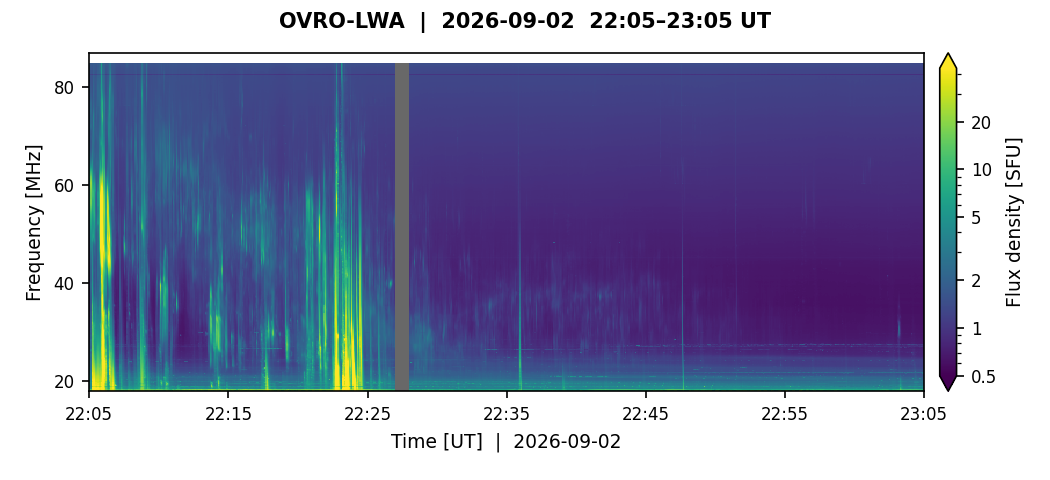
2026 Sep 02 | OVRO-LWA observed a type IV radio burst from 22:05 to 23:05 UT. The burst may be associated with a GOES C1.8-class flare at N10E84 (21:54–22:22 UT; peak 22:08 UT). EOVSA detected weak or no microwave signal. The LWA spectrum shows a weak continuum with negative circular polarization (V/I ≈ −0.15 at 30–60 MHz), distinct from the unpolarized emission earlier in the day. | Weak or no microwave signal. | Weak or no microwave signal. |
|  Stokes I spectral-image preview (22:08:56 UT) · Play movie · Download fine-channel HDF5 data (18.17–86.70 MHz; Typical cadence: ≈20–30 s; 180 spectral channels at 0.383 MHz resolution; 10 s integrations) | 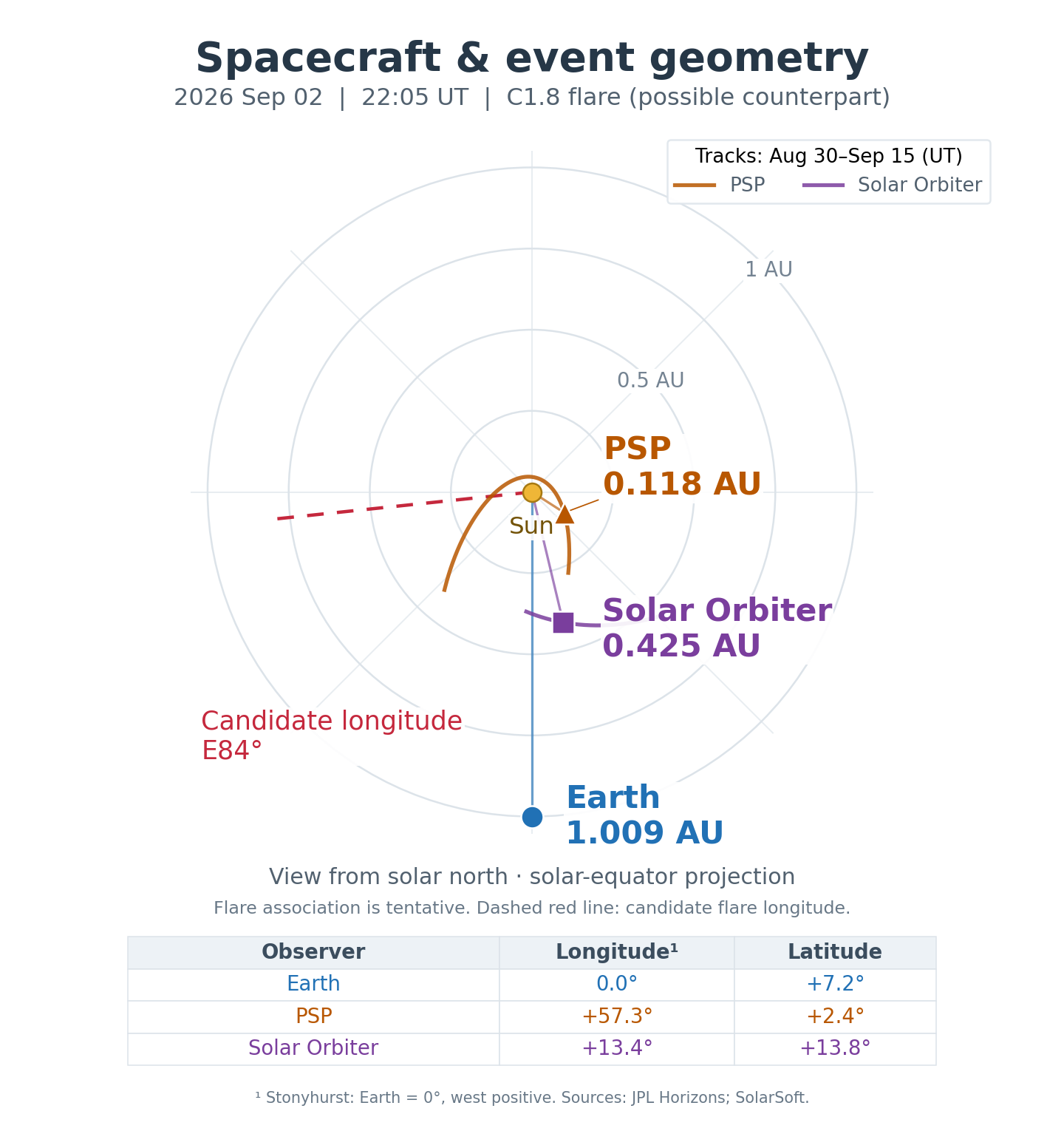 Geometry at 22:05 UT. Possible C1.8 flare counterpart at N10E84; association is tentative. Solar-north view; spacecraft positions projected onto the solar equator. Full-size plot · Positions: JPL Horizons; Flare: SolarSoft. | OVRO-LWA: Peijin Zhang SoD: Mallory Wickline |
2026 Sep 03 | An impulsive GOES C6.9-class flare at N10E40 produced a weak EOVSA microwave burst centered around 4 GHz. |  Cross-power preview · Download FITS data: Cross-power (1.1–18.0 GHz; Sampling: 1.0 s, 0.011–0.041 GHz within bands) | 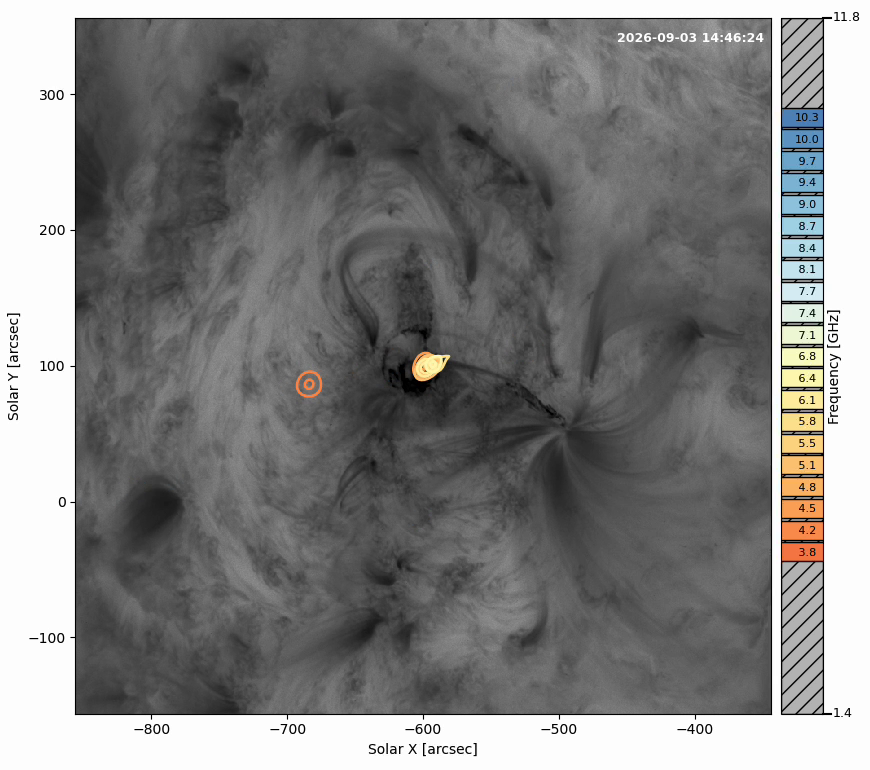 Spectral-image preview · Play movie · Download FITS data (3.84–10.34 GHz; Sampling: 4 s, 21 spectral channels at ≈0.325 GHz spacing) Antennas used for imaging: 1, 4, 5, 6, 8, 9, 10, 11. Low solar elevation compromises the east–west resolution. The multiple sources in the E-W direction are likely an artifact of forcing a circular restoring beam. | No OVRO-LWA beamformer spectrogram data are available for this interval (the 3 September beamformer archive begins at 16:58 UT). Interferometric imaging data are available. | Stokes I spectral images · Download fine-channel HDF5 data (18.17–86.70 MHz; Typical cadence: ≈10–30 s; 180 spectral channels at 0.383 MHz resolution; 10 s integrations) Interferometric imaging data are available for this interval. | 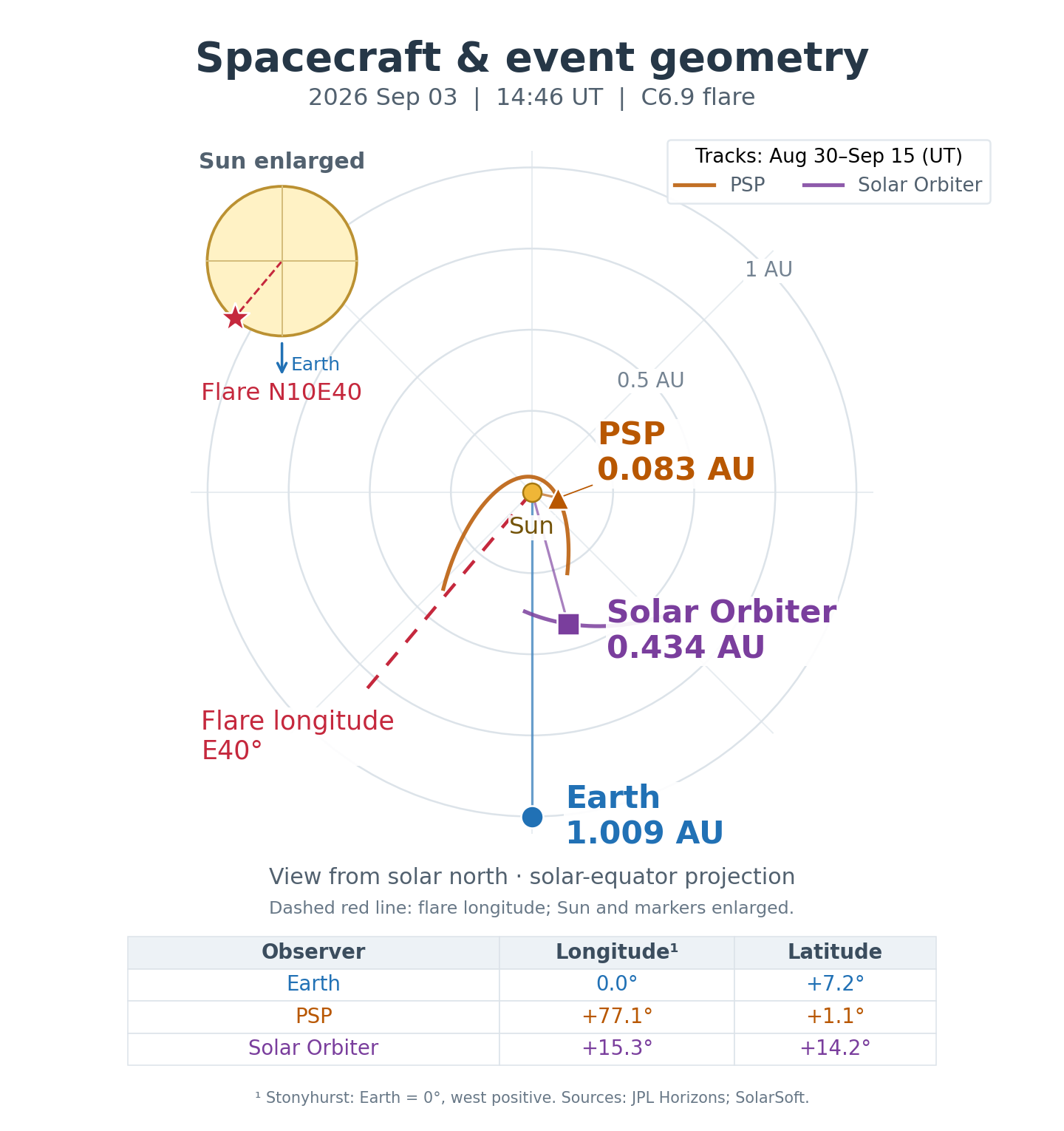 Geometry at 14:46 UT. C6.9 flare at N10E40. Solar-north view; spacecraft positions projected onto the solar equator. Inset: enlarged Sun. Full-size plot · Positions: JPL Horizons; Flare: SolarSoft. | EOVSA: Meiqi Wang |
2026 Sep 03 | An impulsive GOES C7.9-class flare occurred at N11E70. EOVSA observed a microwave burst. |  Cross-power preview · Download FITS data: Total-power · Cross-power (1.1–18.0 GHz; Sampling: 1.0 s, 0.011–0.041 GHz within bands) | 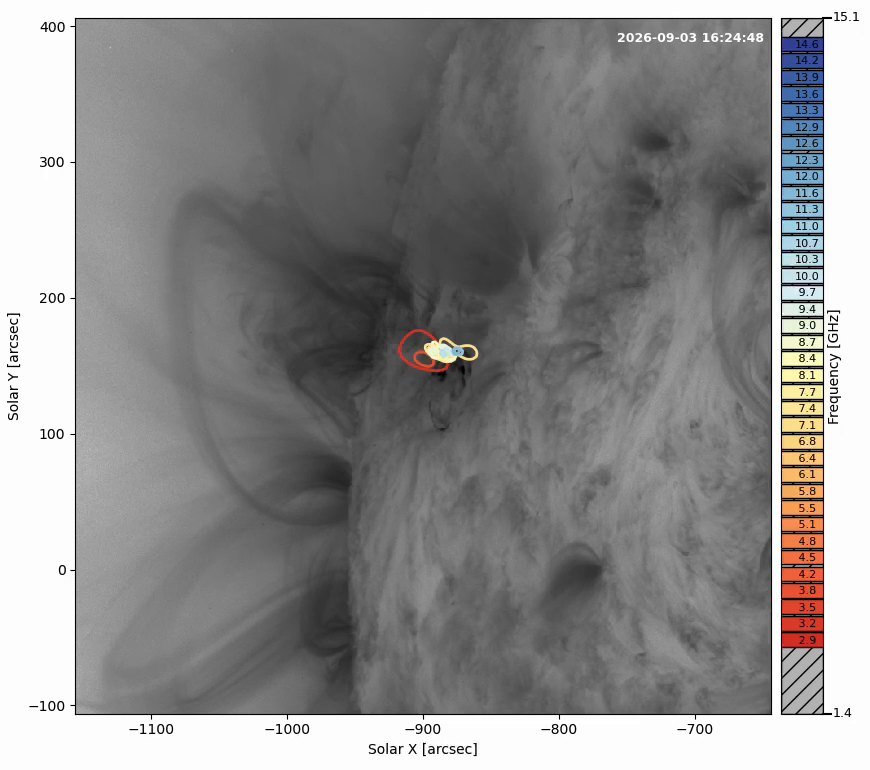 Spectral-image preview · Play movie · Download FITS data (2.87–14.57 GHz; Sampling: 4 s, 37 spectral channels at ≈0.325 GHz spacing) Antennas used for imaging: 1, 3, 4, 5, 6, 8, 9, 10, 11, 13. | No OVRO-LWA beamformer spectrogram data are available for this interval (the 3 September beamformer archive begins at 16:58 UT). Interferometric imaging data are available. | Stokes I spectral images · Download fine-channel HDF5 data (18.17–86.70 MHz; Typical cadence: ≈10–30 s; 180 spectral channels at 0.383 MHz resolution; 10 s integrations) Interferometric imaging data are available for this interval. | 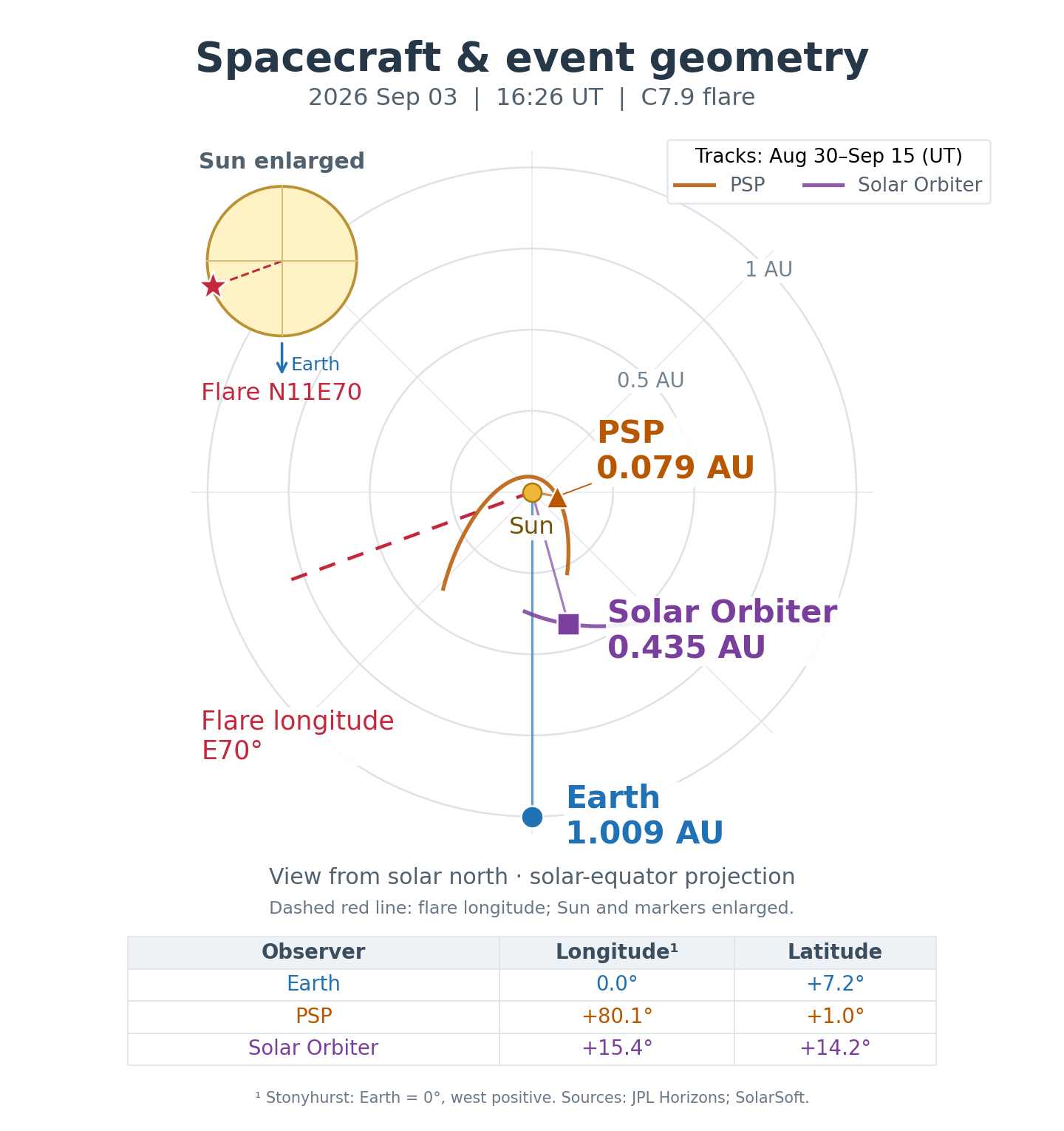 Geometry at 16:26 UT. C7.9 flare at N11E70. Solar-north view; spacecraft positions projected onto the solar equator. Inset: enlarged Sun. Full-size plot · Positions: JPL Horizons; Flare: SolarSoft. | EOVSA: Meiqi Wang |
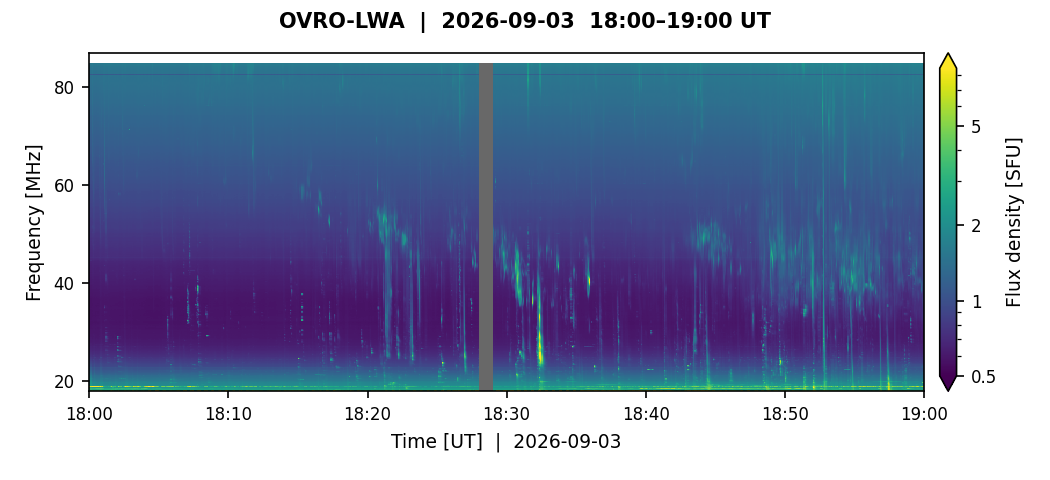
2026 Sep 03 | A GOES C3.0-class flare at N10E37 (18:22–18:33 UT, peak 18:29). EOVSA observed a weak microwave burst. No OVRO-LWA event is listed; OVRO-LWA data for 18:00–19:00 UT are linked for context. |  Cross-power preview · Download FITS data: Total-power · Cross-power (1.1–18.0 GHz; Sampling: 1.0 s, 0.011–0.041 GHz within bands) | Microwave signal too weak for spectral imaging |
|  Stokes I spectral-image preview (18:29:55 UT) · Play movie · Download fine-channel HDF5 data (18.17–86.70 MHz; Typical cadence: ≈10–30 s; 180 spectral channels at 0.383 MHz resolution; 10 s integrations) | 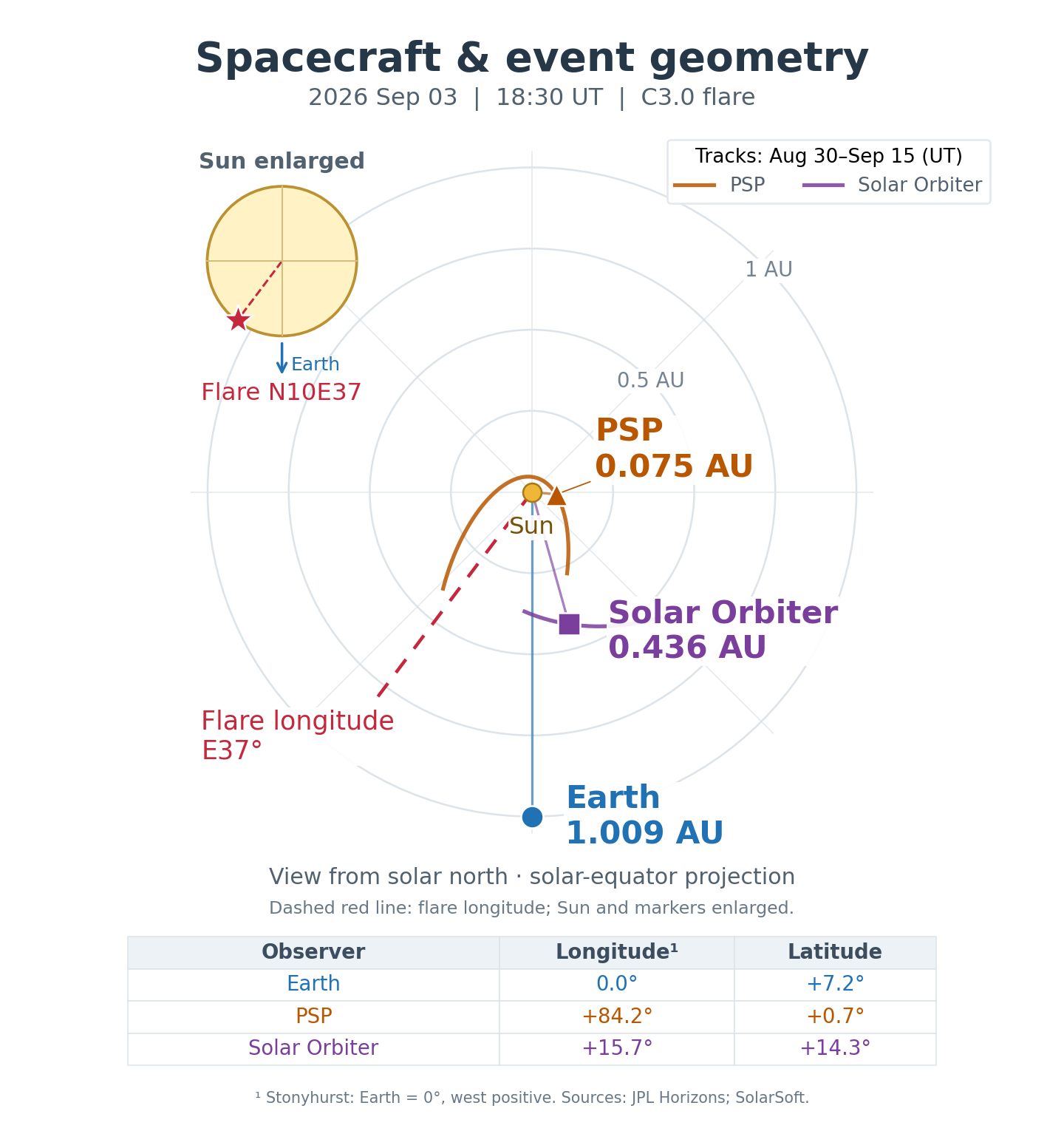 Geometry at 18:30 UT. C3.0 flare at N10E37. Solar-north view; spacecraft positions projected onto the solar equator. Inset: enlarged Sun. Full-size plot · Positions: JPL Horizons; Flare: SolarSoft. | EOVSA: Meiqi Wang |
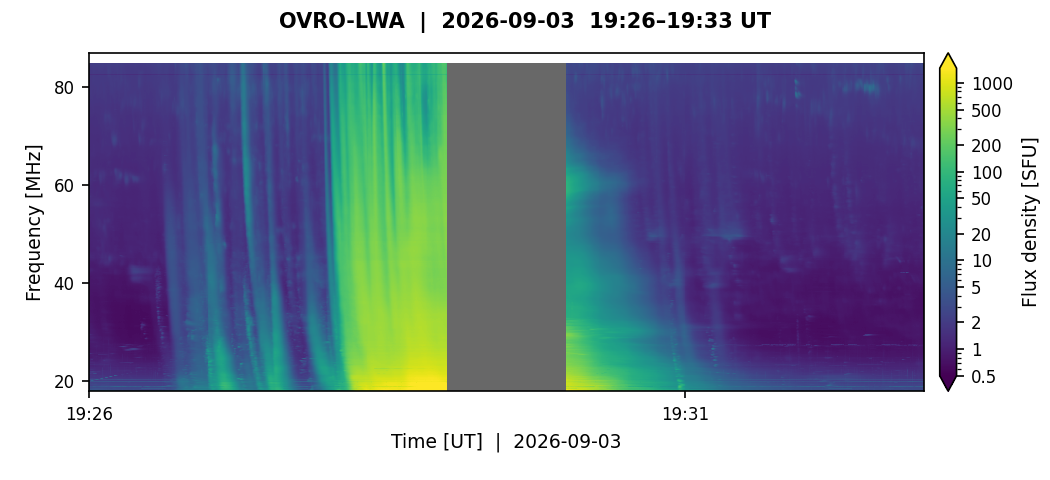
2026 Sep 03 | OVRO-LWA bright type III burst group (19:26–19:33 UT). EOVSA detected weak or no microwave signal. No GOES flare event is listed in the LMSAL catalogue for this interval. | Weak or no microwave signal. | Weak or no microwave signal. |
|  Stokes I spectral-image preview (19:28:26 UT) · Play movie · Download fine-channel HDF5 data (18.17–86.70 MHz; Typical cadence: ≈10–30 s; 180 spectral channels at 0.383 MHz resolution; 10 s integrations) | 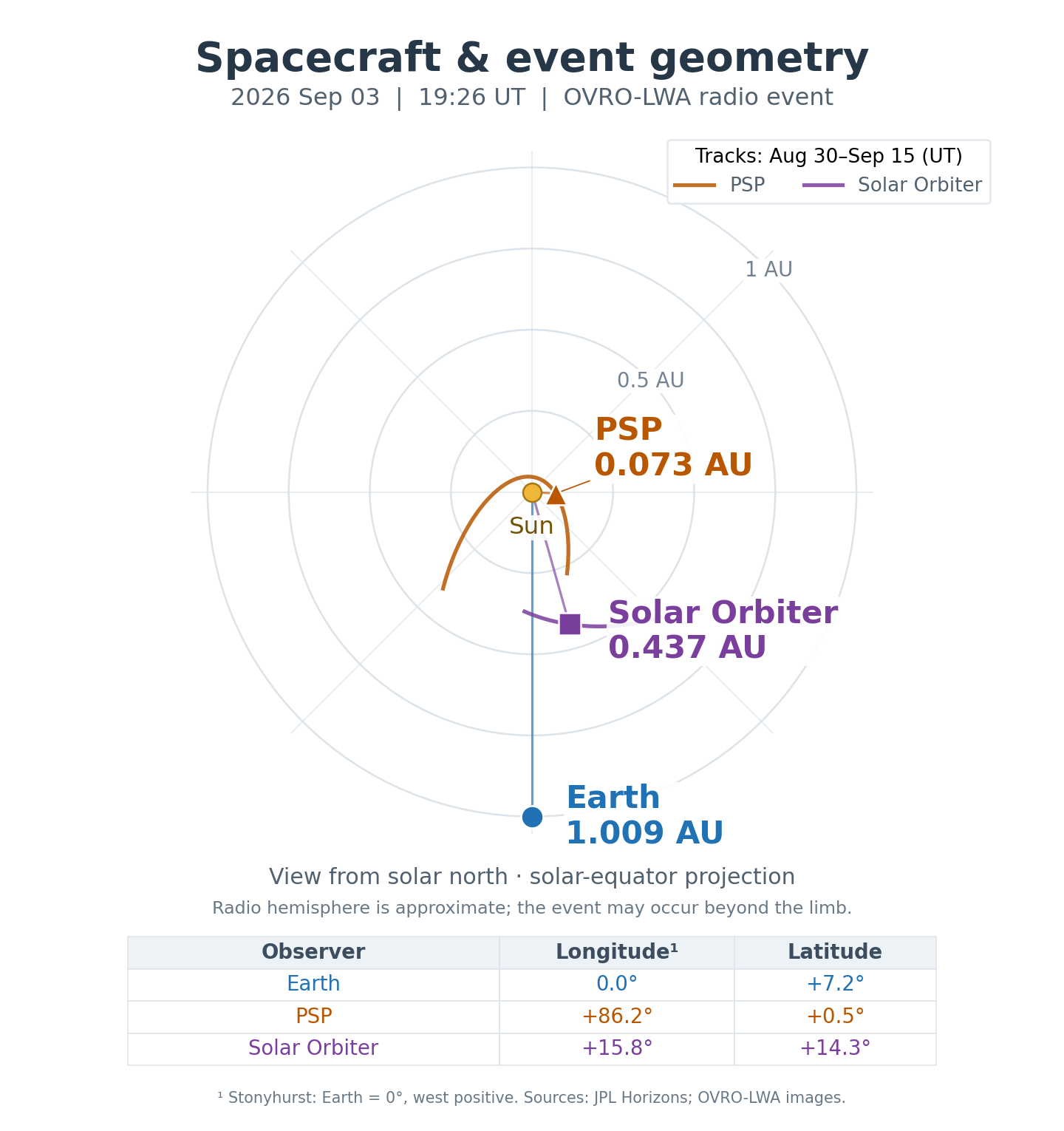 Geometry at 19:26 UT. No identified X-ray counterpart. OVRO-LWA image: eastern hemisphere, near the equator (projected). The event may occur beyond the limb. Solar-north view; spacecraft positions projected onto the solar equator. No precise flare longitude is assigned. Full-size plot · Positions: JPL Horizons; Radio location: OVRO-LWA image (19:28:26 UT). | OVRO-LWA: Peijin Zhang SoD: Meredith Wieber |
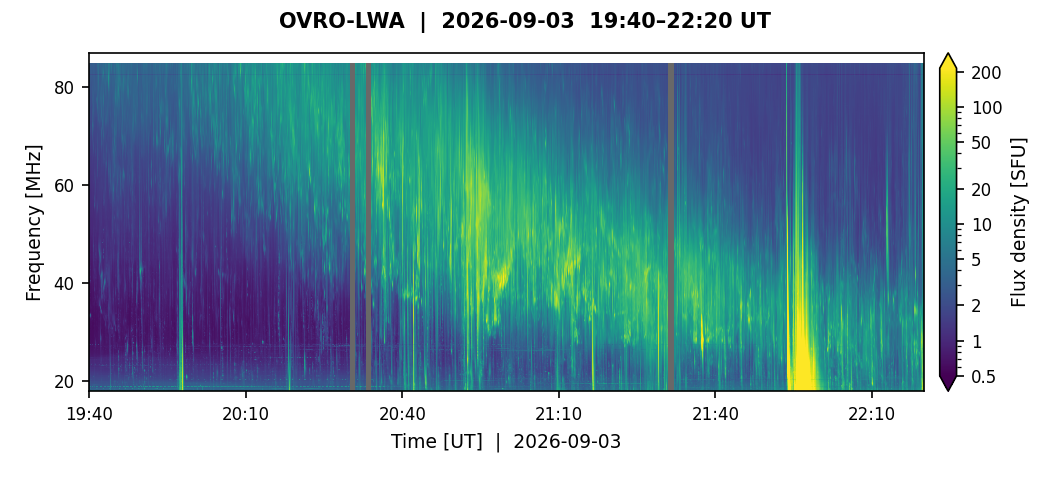
2026 Sep 03 | OVRO-LWA long-duration type IV continuum (19:40–22:20 UT). Imaging shows a widespread source off the eastern limb. EOVSA detected weak or no microwave signal during available coverage. | Weak or no microwave signal. No EOVSA coverage during calibration: 19:50–20:10 UT and 21:30–21:39 UT. | Weak or no microwave signal. |
|  Stokes I spectral-image preview (20:50:01 UT) · Play movie · Download fine-channel HDF5 data (18.17–86.70 MHz; Typical cadence: ≈10–30 s; 180 spectral channels at 0.383 MHz resolution; 10 s integrations) | 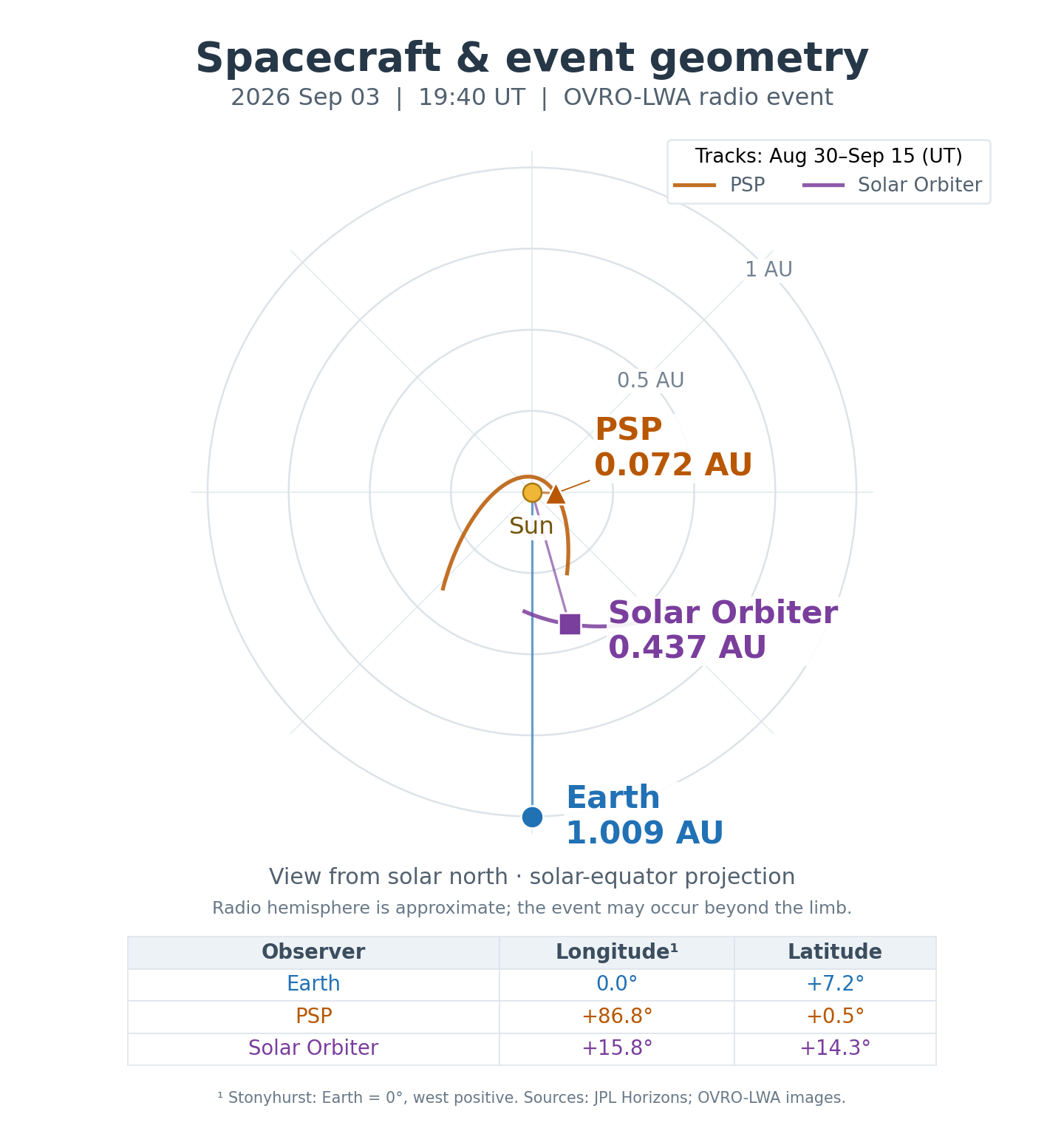 Geometry at 19:40 UT. No identified X-ray counterpart. OVRO-LWA image: northeastern hemisphere (projected). The event may occur beyond the limb. Solar-north view; spacecraft positions projected onto the solar equator. No precise flare longitude is assigned. Full-size plot · Positions: JPL Horizons; Radio location: OVRO-LWA image (20:50:01 UT). | OVRO-LWA: Peijin Zhang SoD: Meredith Wieber |
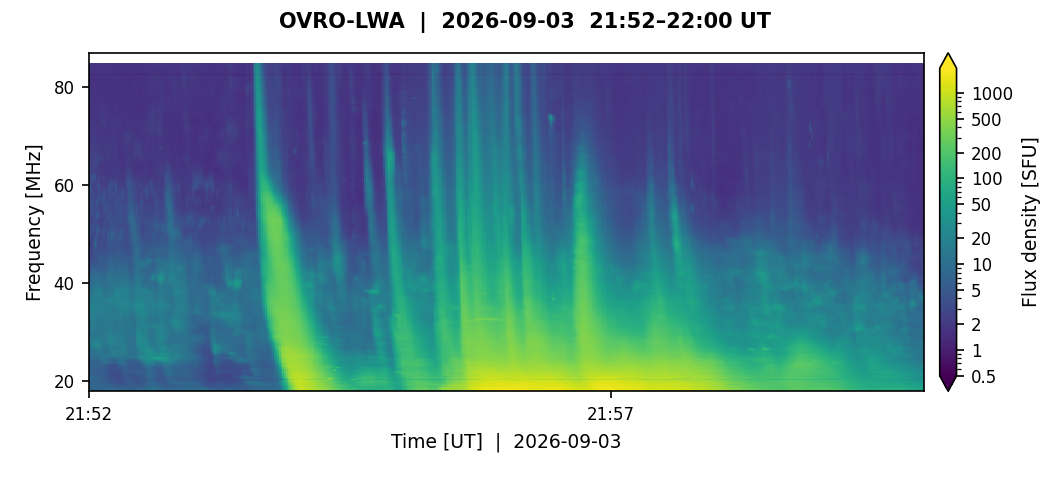
2026 Sep 03 | OVRO-LWA bright type III burst group (21:52–22:00 UT) within the type IV continuum. EOVSA detected weak or no microwave signal. | Weak or no microwave signal. | Weak or no microwave signal. |
|  Stokes I spectral-image preview (21:53:33 UT) · Play movie · Download fine-channel HDF5 data (18.17–86.70 MHz; Typical cadence: ≈10–30 s; 180 spectral channels at 0.383 MHz resolution; 10 s integrations) | 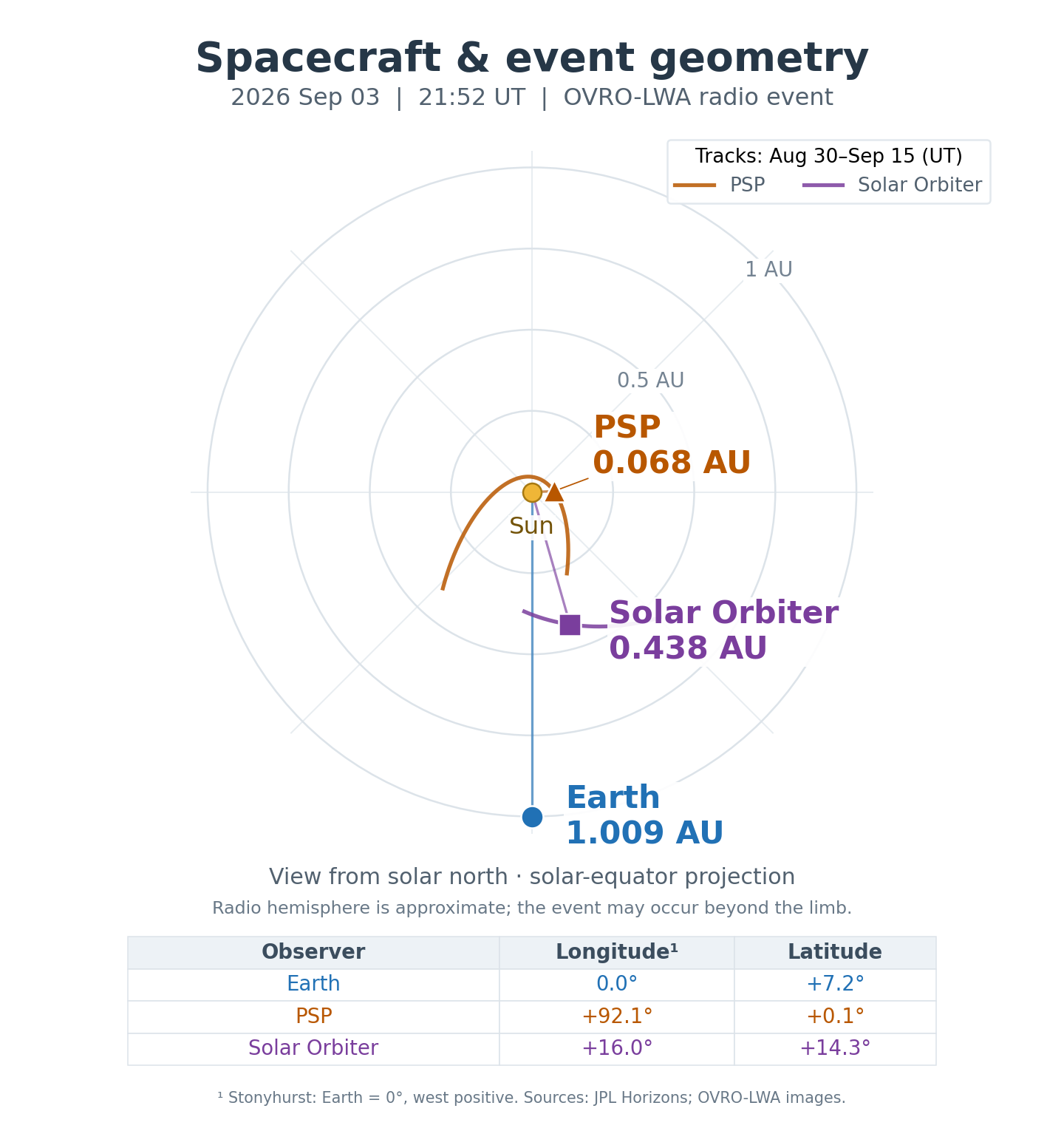 Geometry at 21:52 UT. No identified X-ray counterpart. OVRO-LWA image: northeastern hemisphere (projected). The event may occur beyond the limb. Solar-north view; spacecraft positions projected onto the solar equator. No precise flare longitude is assigned. Full-size plot · Positions: JPL Horizons; Radio location: OVRO-LWA image (21:53:33 UT). | OVRO-LWA: Peijin Zhang SoD: Meredith Wieber |
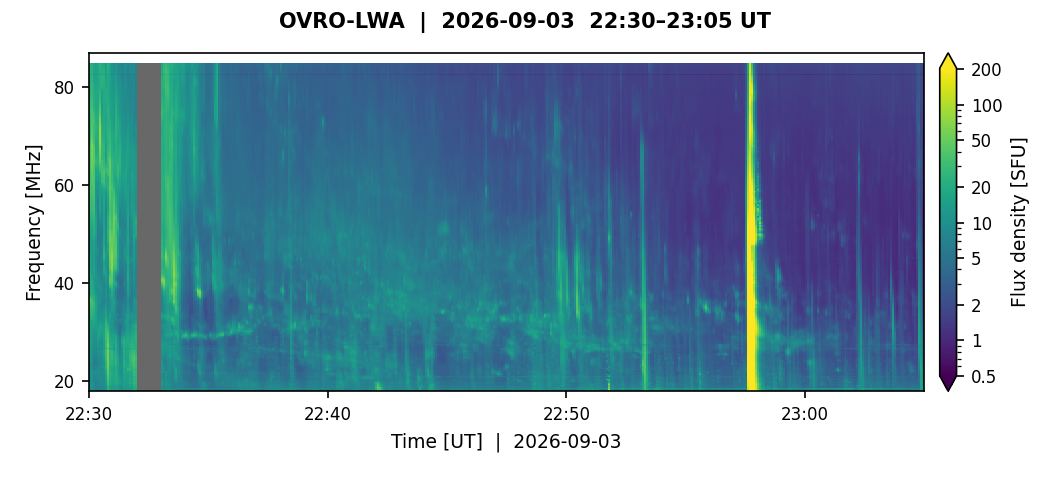
2026 Sep 03 | OVRO-LWA type IV continuum (22:30–23:05 UT). EOVSA detected weak or no microwave signal. | Weak or no microwave signal. | Weak or no microwave signal. |
|  Stokes I spectral-image preview (22:44:02 UT) · Play movie · Download fine-channel HDF5 data (18.17–86.70 MHz; Typical cadence: ≈10–30 s; 180 spectral channels at 0.383 MHz resolution; 10 s integrations) | 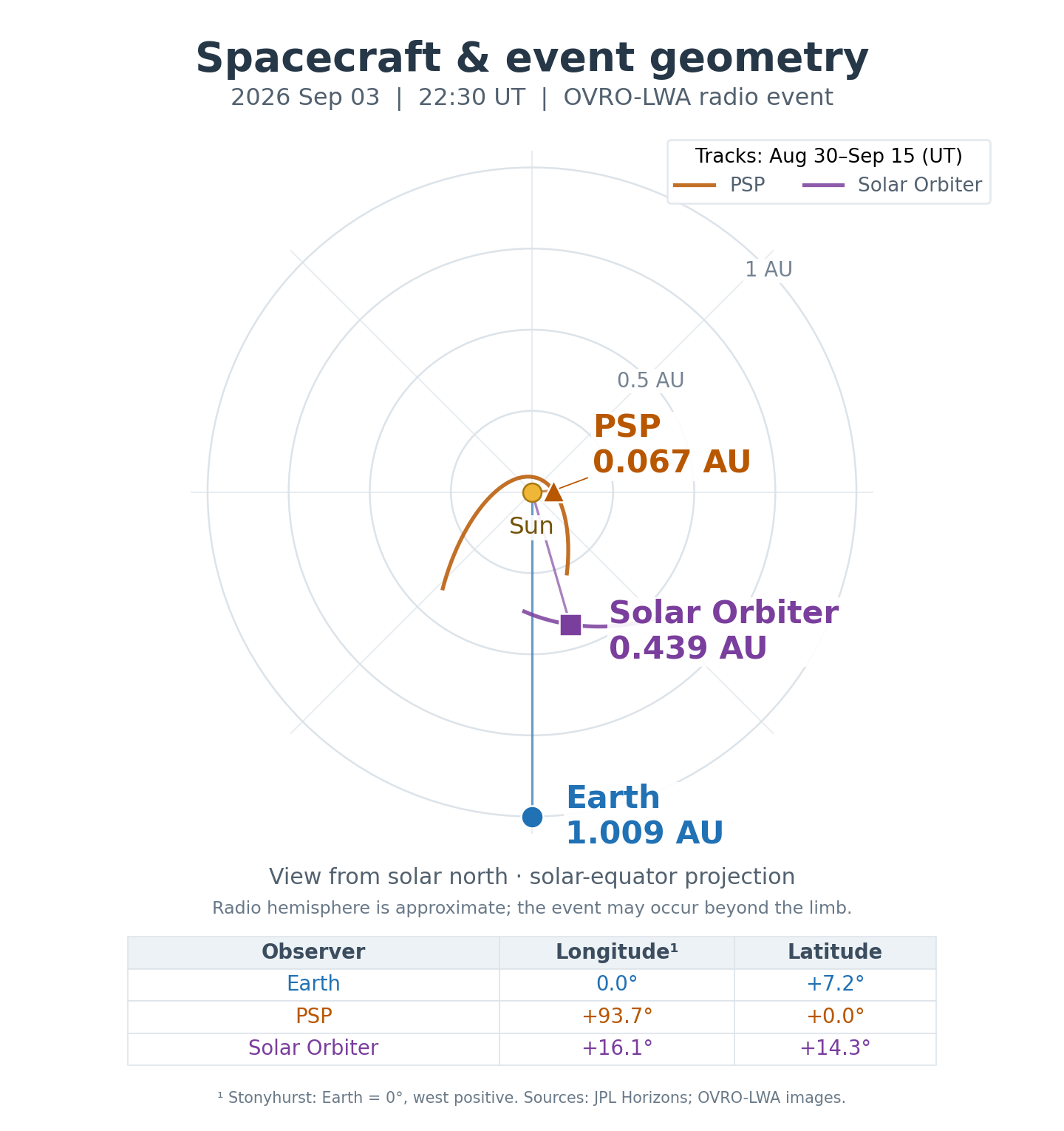 Geometry at 22:30 UT. No identified X-ray counterpart. OVRO-LWA image: southeastern hemisphere (projected). The event may occur beyond the limb. Solar-north view; spacecraft positions projected onto the solar equator. No precise flare longitude is assigned. Full-size plot · Positions: JPL Horizons; Radio location: OVRO-LWA image (22:44:02 UT). | OVRO-LWA: Peijin Zhang SoD: Meredith Wieber |
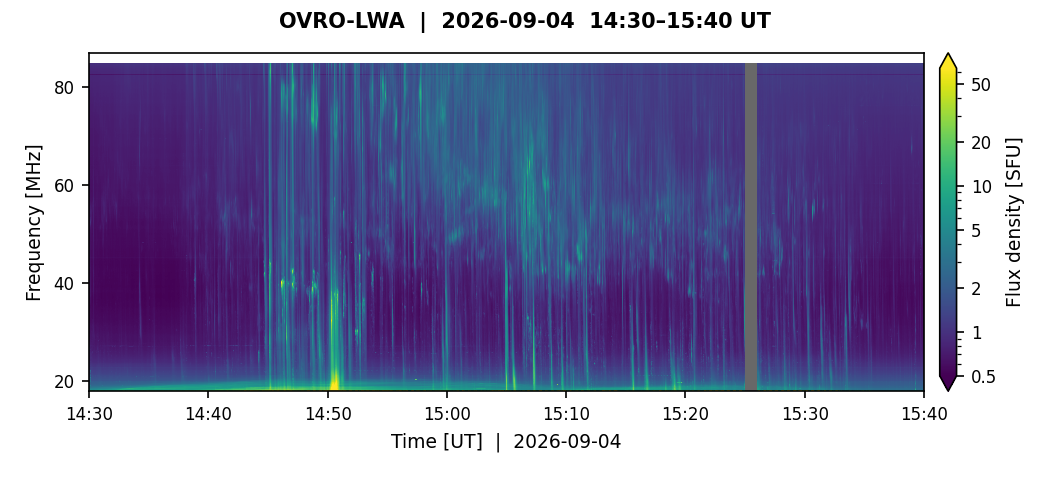
2026 Sep 04 | OVRO-LWA type IV continuum (14:30–15:40 UT) from a source off the southeast limb. No associated X-ray flare has been identified; the event may occur beyond the limb. EOVSA detected weak or no microwave signal during available coverage. | Weak or no microwave signal. No EOVSA coverage during calibration: 15:10–15:30 UT. | Weak or no microwave signal. |
|  Stokes I spectral-image preview (14:58:23 UT) · Play movie · Download fine-channel HDF5 data (18.17–86.70 MHz; Typical cadence: ≈10–30 s; 180 spectral channels at 0.383 MHz resolution; 10 s integrations) | 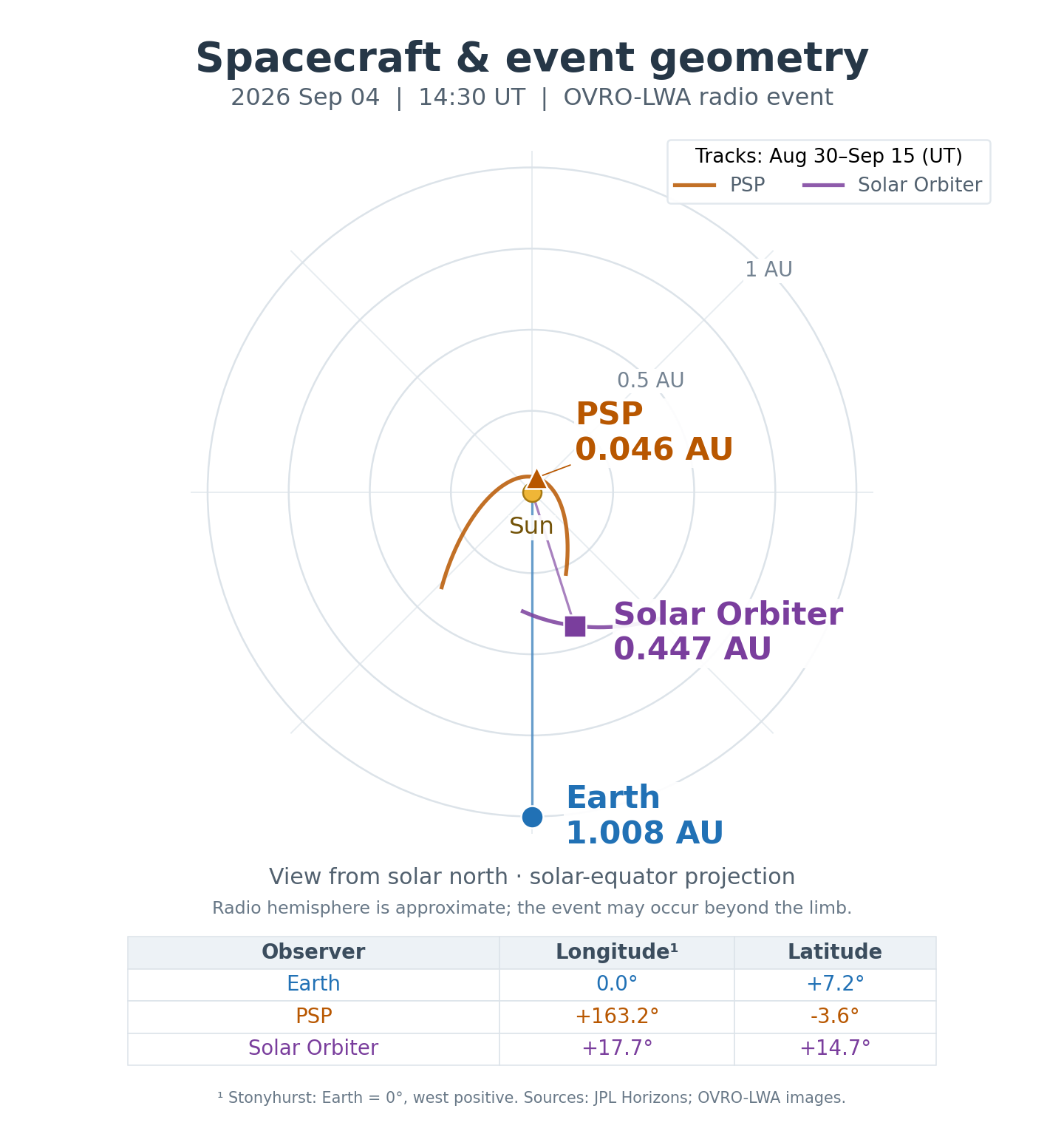 Geometry at 14:30 UT. No identified X-ray counterpart. OVRO-LWA image: southeastern hemisphere (projected). The event may occur beyond the limb. Solar-north view; spacecraft positions projected onto the solar equator. No precise flare longitude is assigned. Full-size plot · Positions: JPL Horizons; Radio location: OVRO-LWA image (14:58:23 UT). | OVRO-LWA: Peijin Zhang SoD: Meredith Wieber |
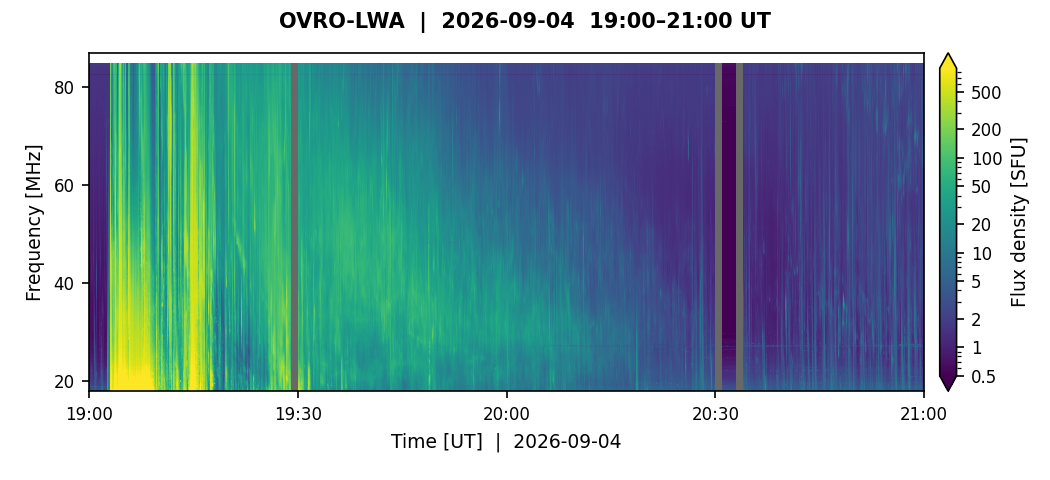
2026 Sep 04 | A GOES C6.7-class flare. EOVSA observed a strong broadband microwave burst with coherent burst signatures in the 1–2 GHz range. OVRO-LWA also observed a strong cluster of bright type III bursts (peaking at ~800 SFU), followed by a strongly negatively polarized type IV storm. |  Cross-power preview · Download FITS data: Total-power · Cross-power (1.1–18.0 GHz; Sampling: 1.0 s, 0.011–0.041 GHz within bands) | 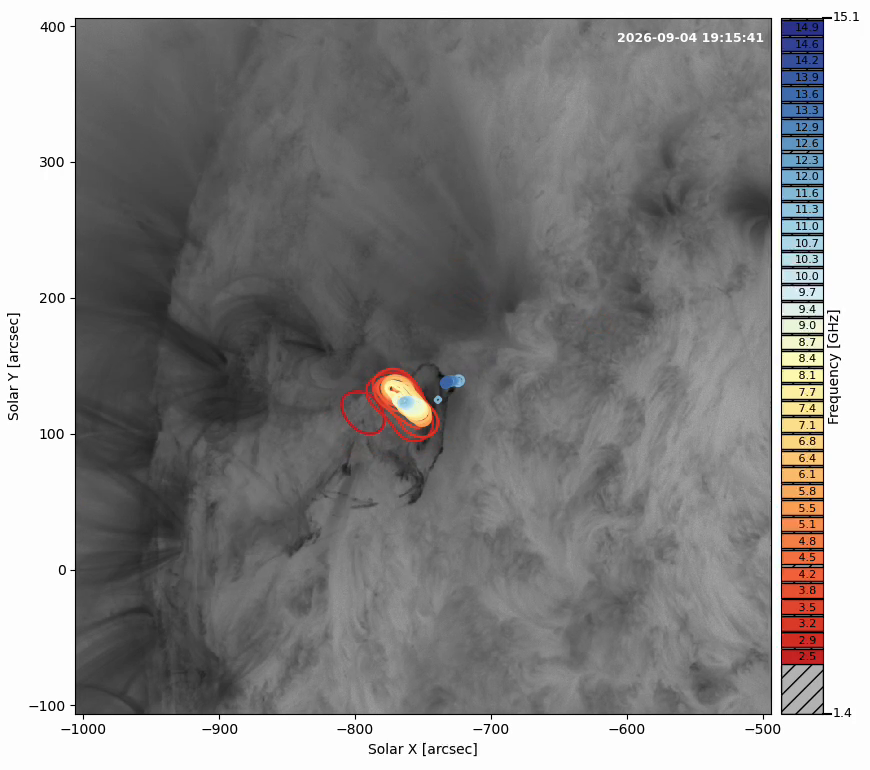 Spectral-image preview · Play movie · Download FITS data (2.55–14.89 GHz; Sampling: 4 s, 39 spectral channels at ≈0.325 GHz spacing) Antennas used for imaging: 1, 3, 4, 5, 6, 8, 9, 10, 11, 13. |
|  Stokes I spectral-image preview (19:15:01 UT) · Play movie · Download fine-channel HDF5 data (18.17–86.70 MHz; Typical cadence: ≈20–30 s; 180 spectral channels at 0.383 MHz resolution; 10 s integrations) | 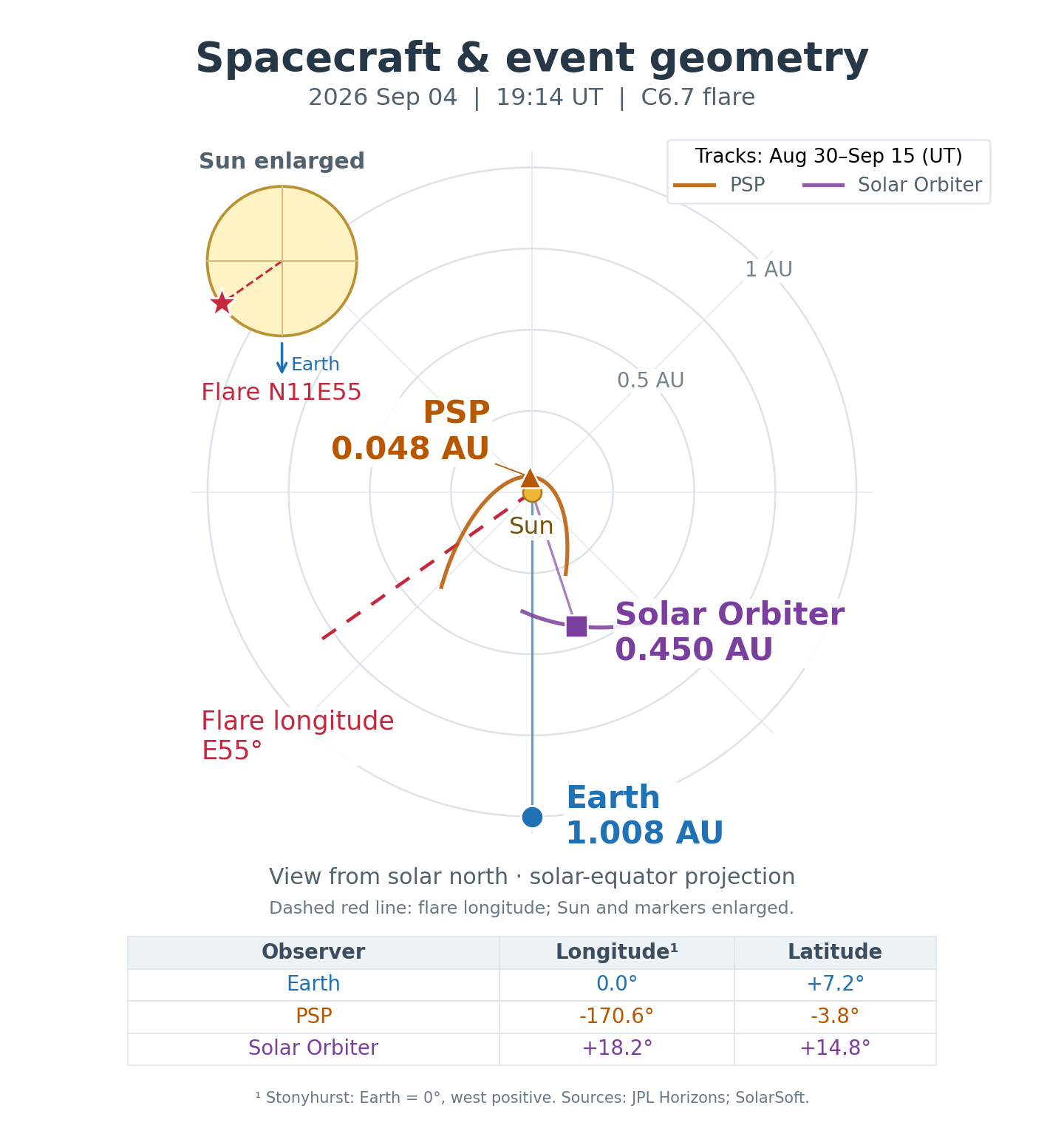 Geometry at 19:14 UT. C6.7 flare at N11E55. Solar-north view; spacecraft positions projected onto the solar equator. Inset: enlarged Sun. Full-size plot · Positions: JPL Horizons; Flare: SolarSoft. | EOVSA: Meiqi Wang |
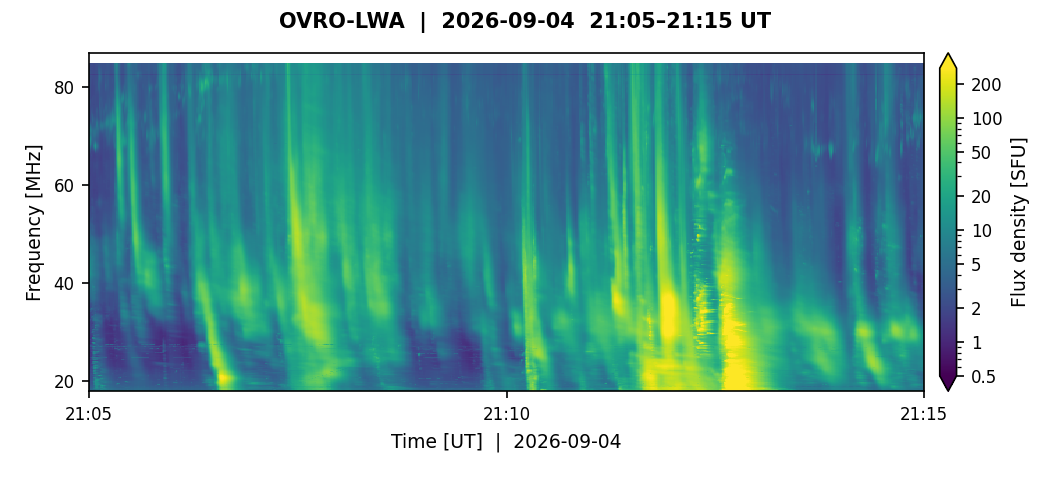
2026 Sep 04 | OVRO-LWA bright type III burst group (21:05–21:15 UT) at the onset of a GOES C1.2 flare (21:02–21:38 UT, peak 21:21, S07E88, east limb). EOVSA detected weak or no microwave signal. | Weak or no microwave signal. | Weak or no microwave signal. |
|  Stokes I spectral-image preview (21:07:32 UT) · Play movie · Download fine-channel HDF5 data (18.17–86.70 MHz; Typical cadence: ≈10–30 s; 180 spectral channels at 0.383 MHz resolution; 10 s integrations) | 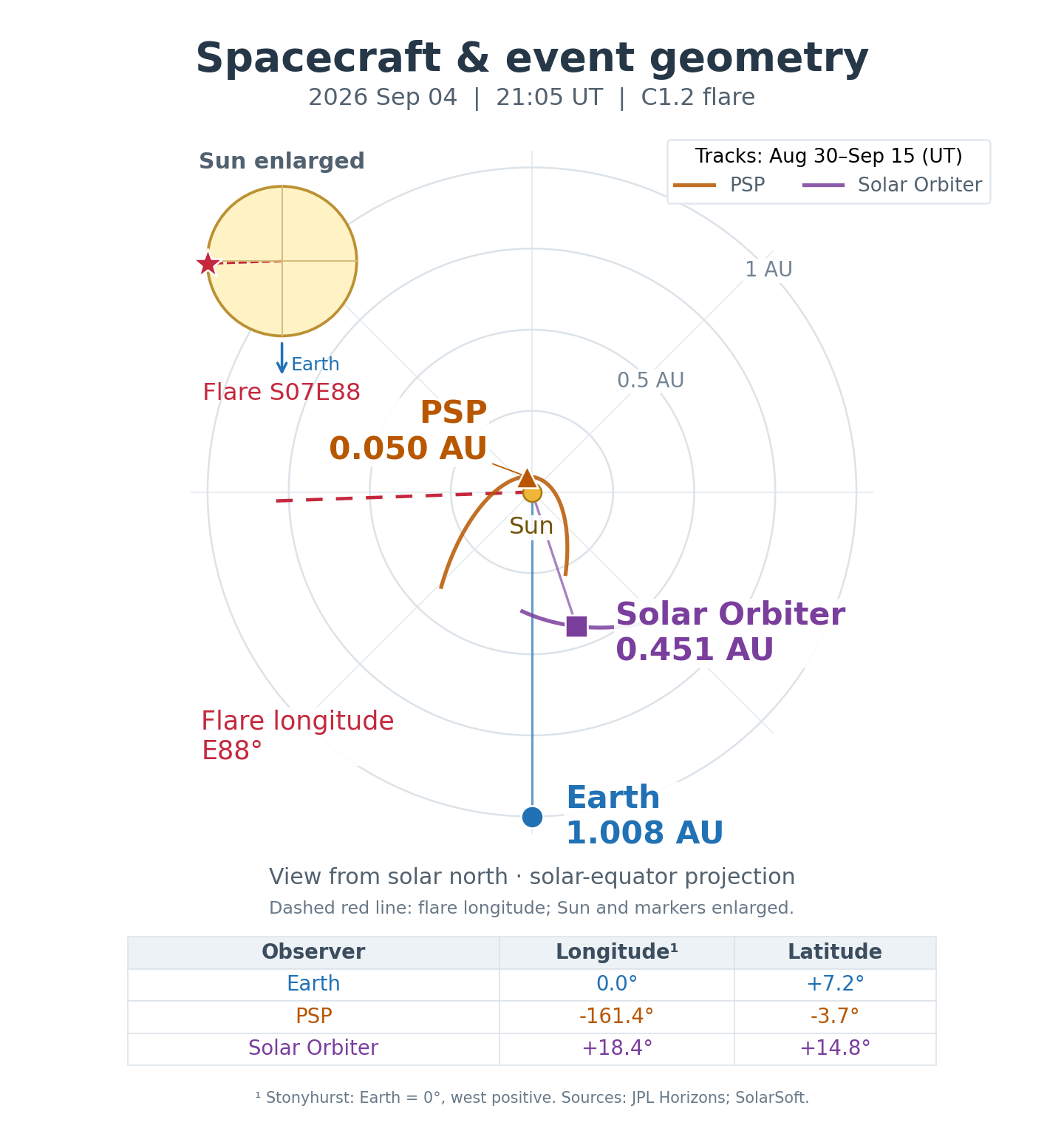 Geometry at 21:05 UT. C1.2 flare at S07E88. Solar-north view; spacecraft positions projected onto the solar equator. Inset: enlarged Sun. Full-size plot · Positions: JPL Horizons; Flare: SolarSoft. | OVRO-LWA: Peijin Zhang SoD: Meredith Wieber |
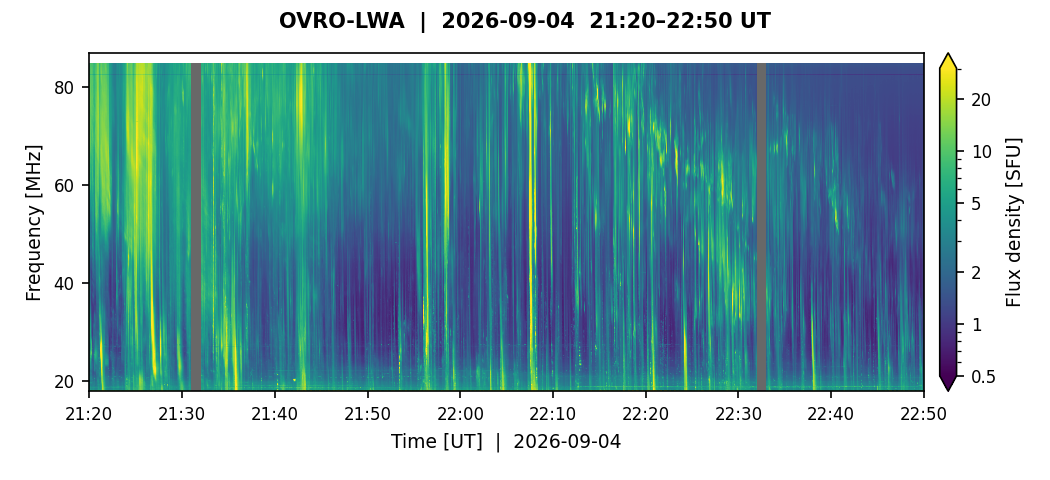
2026 Sep 04 | OVRO-LWA type IV continuum (21:20–22:50 UT) following the type III burst group, during and after the C1.2 flare. EOVSA detected weak or no microwave signal during available coverage. | Weak or no microwave signal. No EOVSA coverage during solar pointing calibration: 21:30–21:39 UT. | Weak or no microwave signal. |
|  Stokes I spectral-image preview (21:39:28 UT) · Play movie · Download fine-channel HDF5 data (18.17–86.70 MHz; Typical cadence: ≈10–30 s; 180 spectral channels at 0.383 MHz resolution; 10 s integrations) | 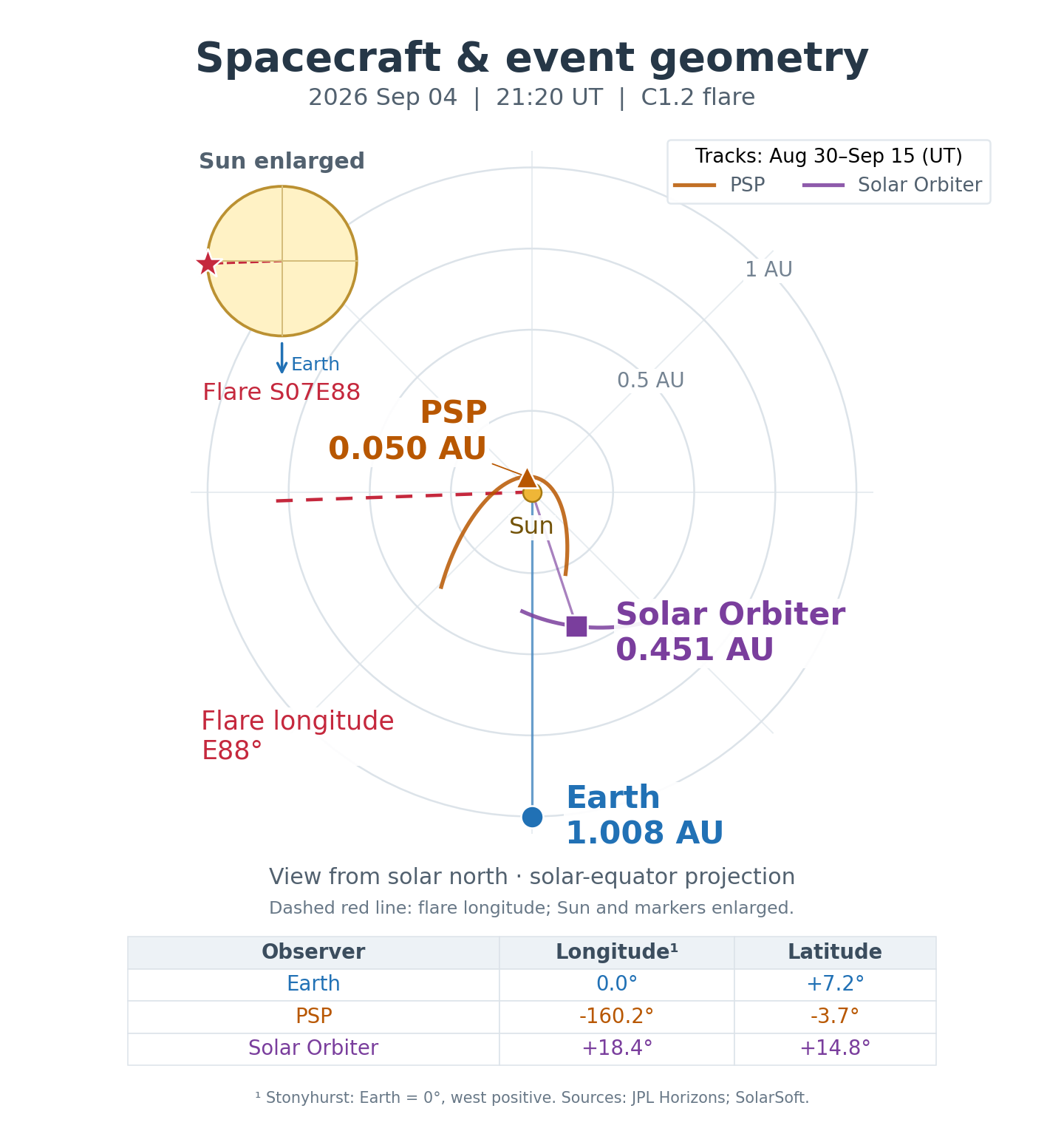 Geometry at 21:20 UT. C1.2 flare at S07E88. Solar-north view; spacecraft positions projected onto the solar equator. Inset: enlarged Sun. Full-size plot · Positions: JPL Horizons; Flare: SolarSoft. | OVRO-LWA: Peijin Zhang SoD: Meredith Wieber |
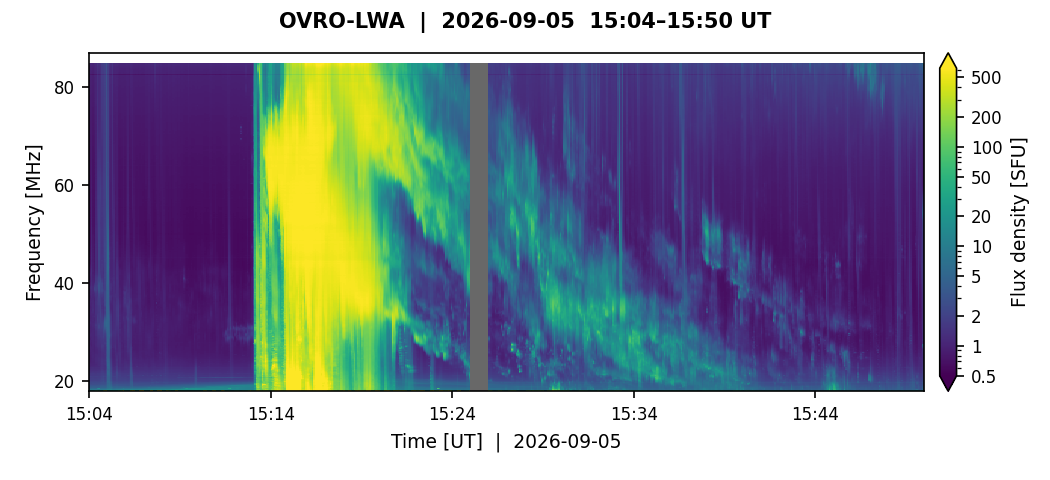
2026 Sep 05 | SEP event at Earth and Solar Orbiter NOAA/GOES: S1 proton event (>10 MeV): onset 16:15 UT; peak 18 pfu at 16:45 UT (record). Solar Orbiter/EPD: Electron and ion SEP event, tentatively associated with this eruption. A GOES M1.0-class flare began at 15:04 UT at S12W68 and was associated with a CME on the western limb. OVRO-LWA observed an intense type II burst developing after approximately 15:13 UT, with flux exceeding 600 s.f.u. OVRO-LWA imaging shows a single source near the flare origin with brightness temperature reaching 7800 MK. EOVSA observed only the late decay phase, with weak microwave flux. |  Cross-power preview · Download FITS data: Total-power · Cross-power (1.1–18.0 GHz; Sampling: 1.0 s, 0.011–0.041 GHz within bands) |  Spectral-image preview · Play movie · Download FITS data (3.52–14.57 GHz; Sampling: 4 s, 35 spectral channels at ≈0.325 GHz spacing) Antennas used for imaging: 1, 3, 4, 5, 6, 8, 9, 10, 11. |
|  Stokes I spectral-image preview (15:17:04 UT) · Play movie · Download fine-channel HDF5 data (18.17–86.70 MHz; Typical cadence: ≈20–30 s; 180 spectral channels at 0.383 MHz resolution; 10 s integrations) | 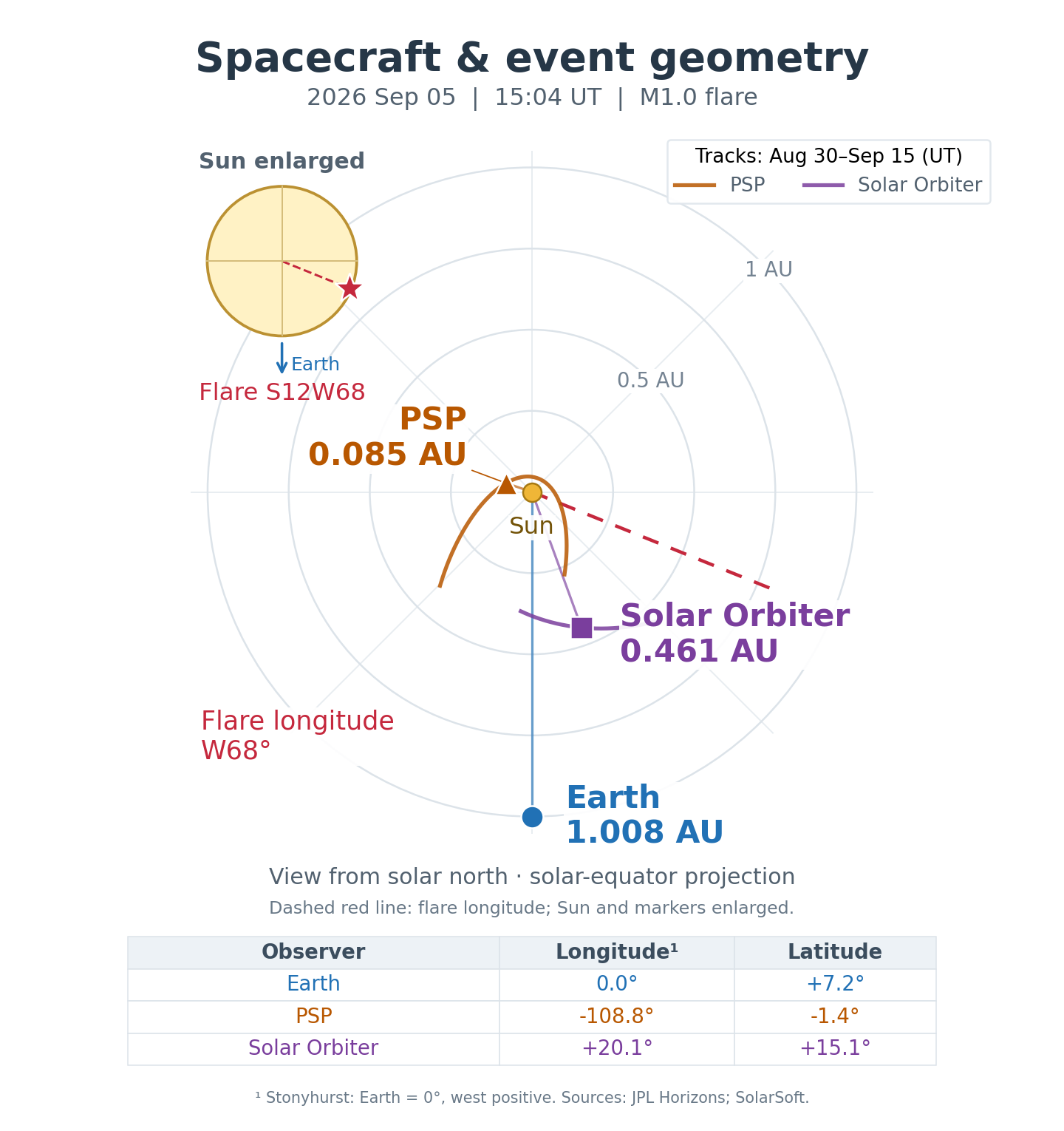 Geometry at 15:04 UT. M1.0 flare at S12W68. Solar-north view; spacecraft positions projected onto the solar equator. Inset: enlarged Sun. Full-size plot · Positions: JPL Horizons; Flare: SolarSoft. |
OVRO-LWA: Peijin Zhang SoD: Ivan Oparin |
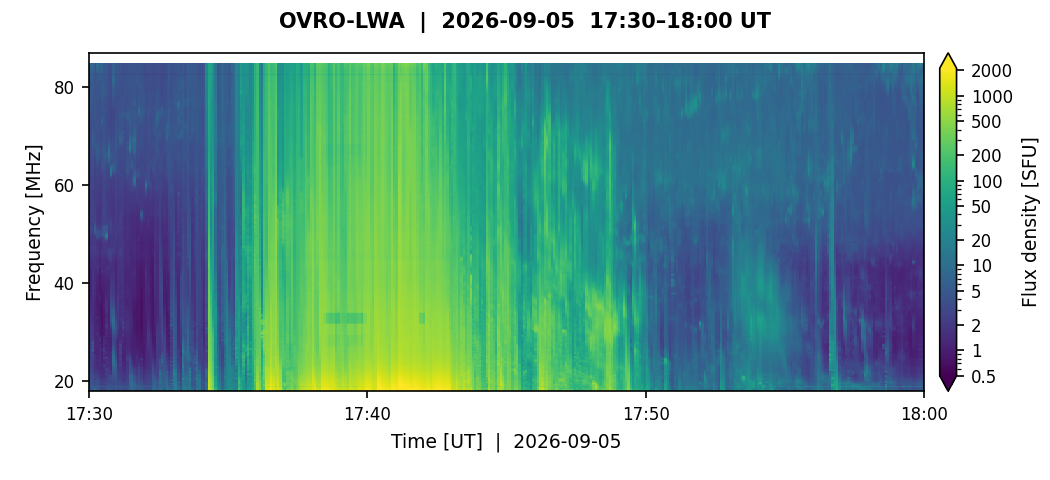
2026 Sep 05 | A GOES C8.5-class flare occurred. EOVSA observed a broadband microwave burst during the impulsive phase of the flare. The association with a southeastward CME detected at 17:36 UT (CACTUS CME0032; position angle 130°) is tentative. The OVRO-LWA spectrogram shows a strong type III burst storm during the flare peak, followed by a polarized type IV burst. |  Cross-power preview · Download FITS data: Total-power · Cross-power (1.1–18.0 GHz; Sampling: 1.0 s, 0.011–0.041 GHz within bands) | 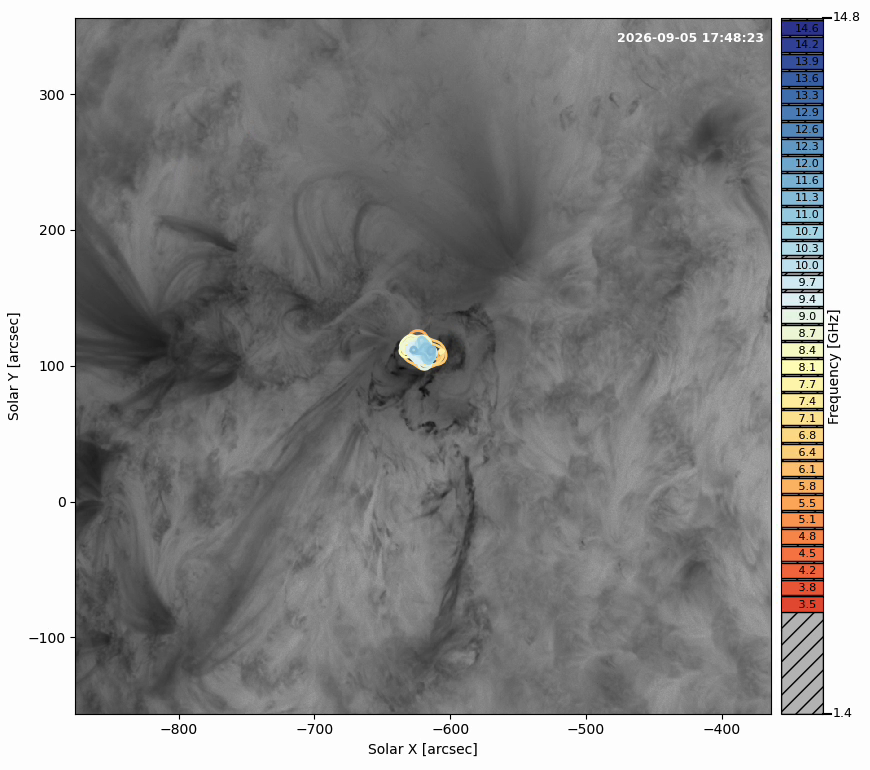 Spectral-image preview · Play movie · Download FITS data (3.52–14.57 GHz; Sampling: 4 s, 35 spectral channels at ≈0.325 GHz spacing) Antennas used for imaging: 1, 3, 4, 5, 6, 9, 10, 11. |
|  Stokes I spectral-image preview (17:41:31 UT) · Play movie · Download fine-channel HDF5 data (18.17–86.70 MHz; Typical cadence: ≈20–30 s; 180 spectral channels at 0.383 MHz resolution; 10 s integrations) | 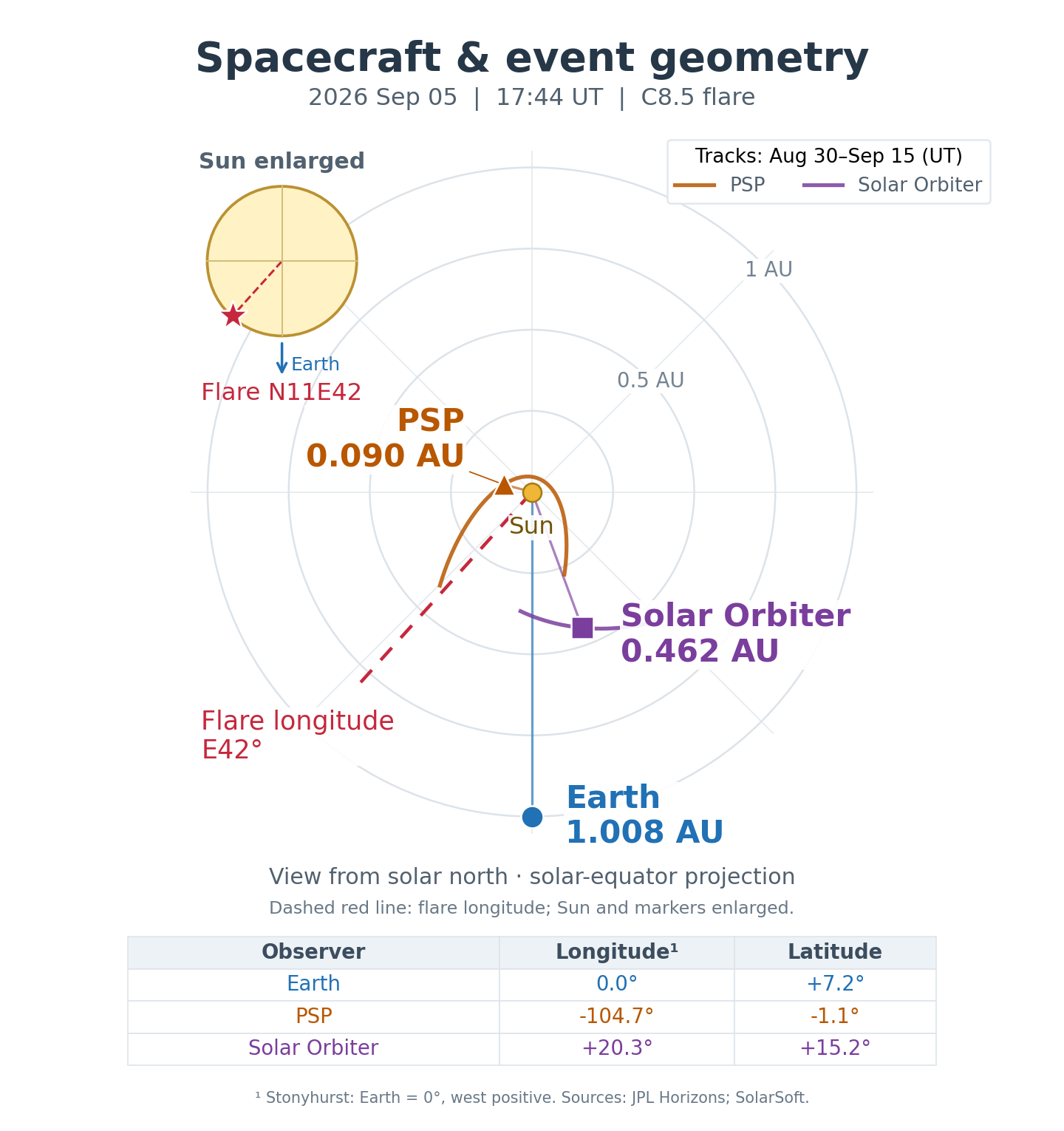 Geometry at 17:44 UT. C8.5 flare at N11E42. Solar-north view; spacecraft positions projected onto the solar equator. Inset: enlarged Sun. Full-size plot · Positions: JPL Horizons; Flare: SolarSoft. | EOVSA: Meiqi Wang |
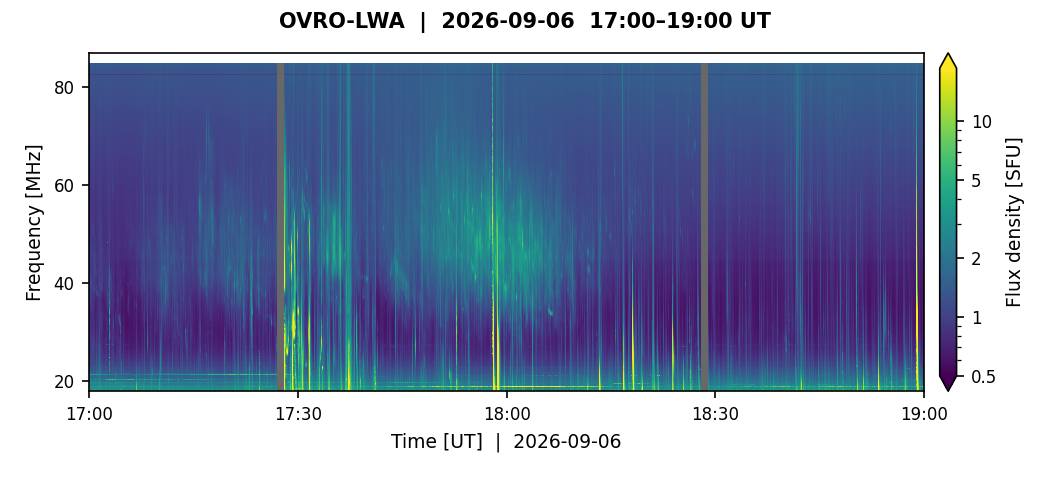
2026 Sep 06 | OVRO-LWA observed a faint type IV burst from a source off the southeast limb (OVRO-LWA image location). Its association with a flare is unclear. | Weak or no microwave signal. No EOVSA coverage during solar pointing calibration: 18:30–18:39 UT. | Weak or no microwave signal. |
|  Stokes I spectral-image preview (17:59:31 UT) · Play movie · Download fine-channel HDF5 data (18.17–86.70 MHz; Typical cadence: ≈20–30 s; 180 spectral channels at 0.383 MHz resolution; 10 s integrations) | 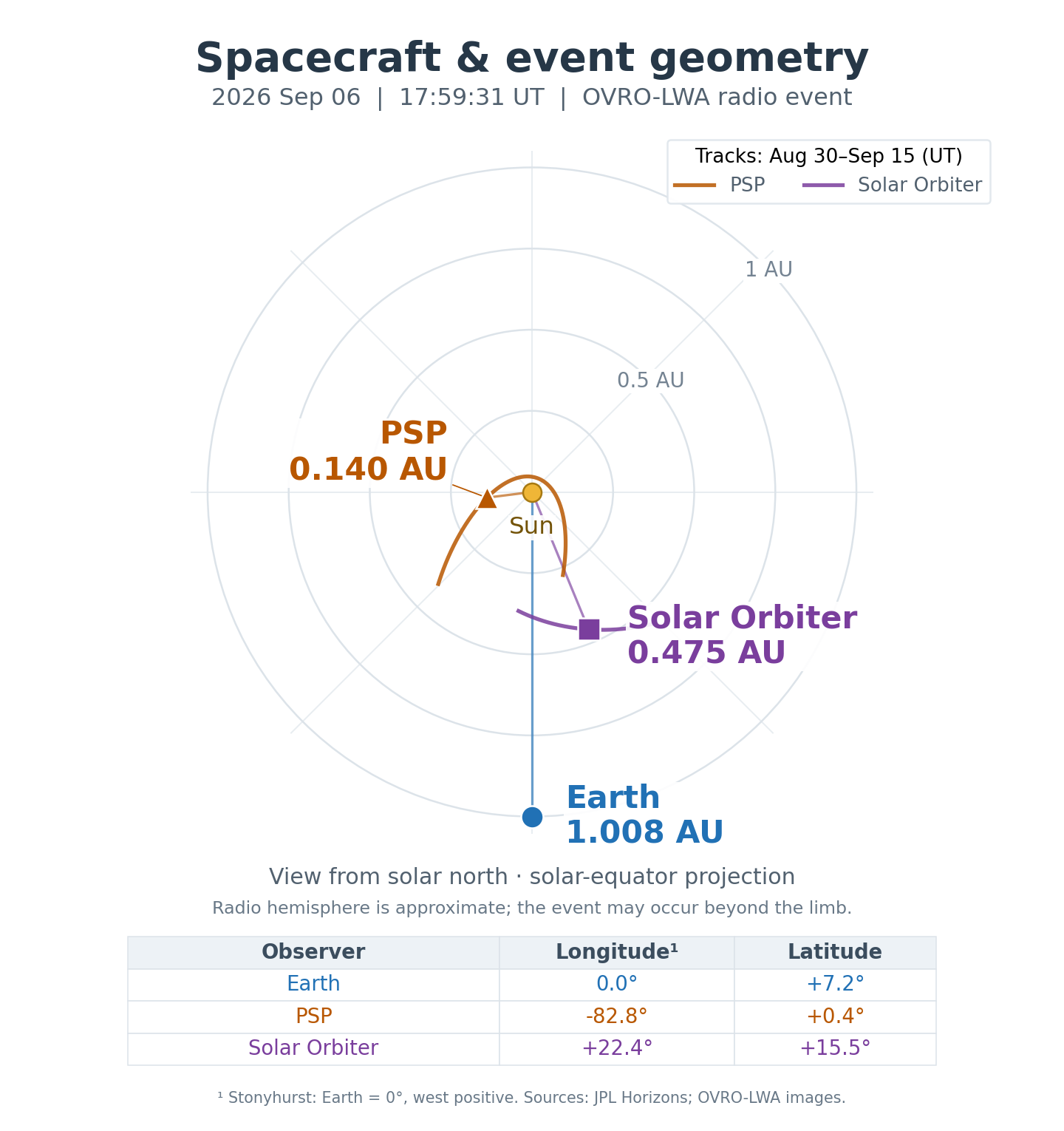 Representative geometry at 17:59:31 UT. No identified X-ray counterpart. OVRO-LWA image: southeastern hemisphere (projected). The event may occur beyond the limb. Solar-north view; spacecraft positions projected onto the solar equator. No precise flare longitude is assigned. Full-size plot · Positions: JPL Horizons; Radio location: OVRO-LWA image (17:59:31 UT). |
OVRO-LWA: Peijin Zhang SoD: Ivan Oparin |
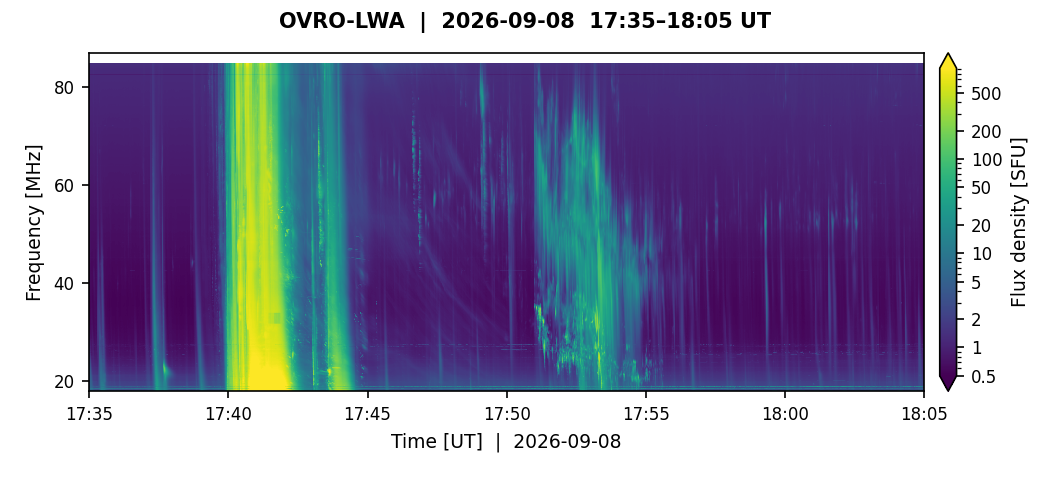
2026 Sep 08 | A GOES C2.8-class flare at N10W37. EOVSA observed a weak microwave burst. OVRO-LWA observed a type III radio burst followed by weak type II radio bursts. OVRO-LWA sources are located at the west limb. An AIA movie shows a jet launching toward the west. The event is possibly associated with a CME. |  Cross-power preview · Download FITS data: Cross-power (1.1–18.0 GHz; Sampling: 1.0 s, 0.011–0.041 GHz within bands) | Microwave signal too weak for spectral imaging |
|  Stokes I spectral-image preview (17:44:13 UT) · Play movie · Download fine-channel HDF5 data (18.17–86.70 MHz; Typical cadence: ≈20–30 s; 180 spectral channels at 0.383 MHz resolution; 10 s integrations) | 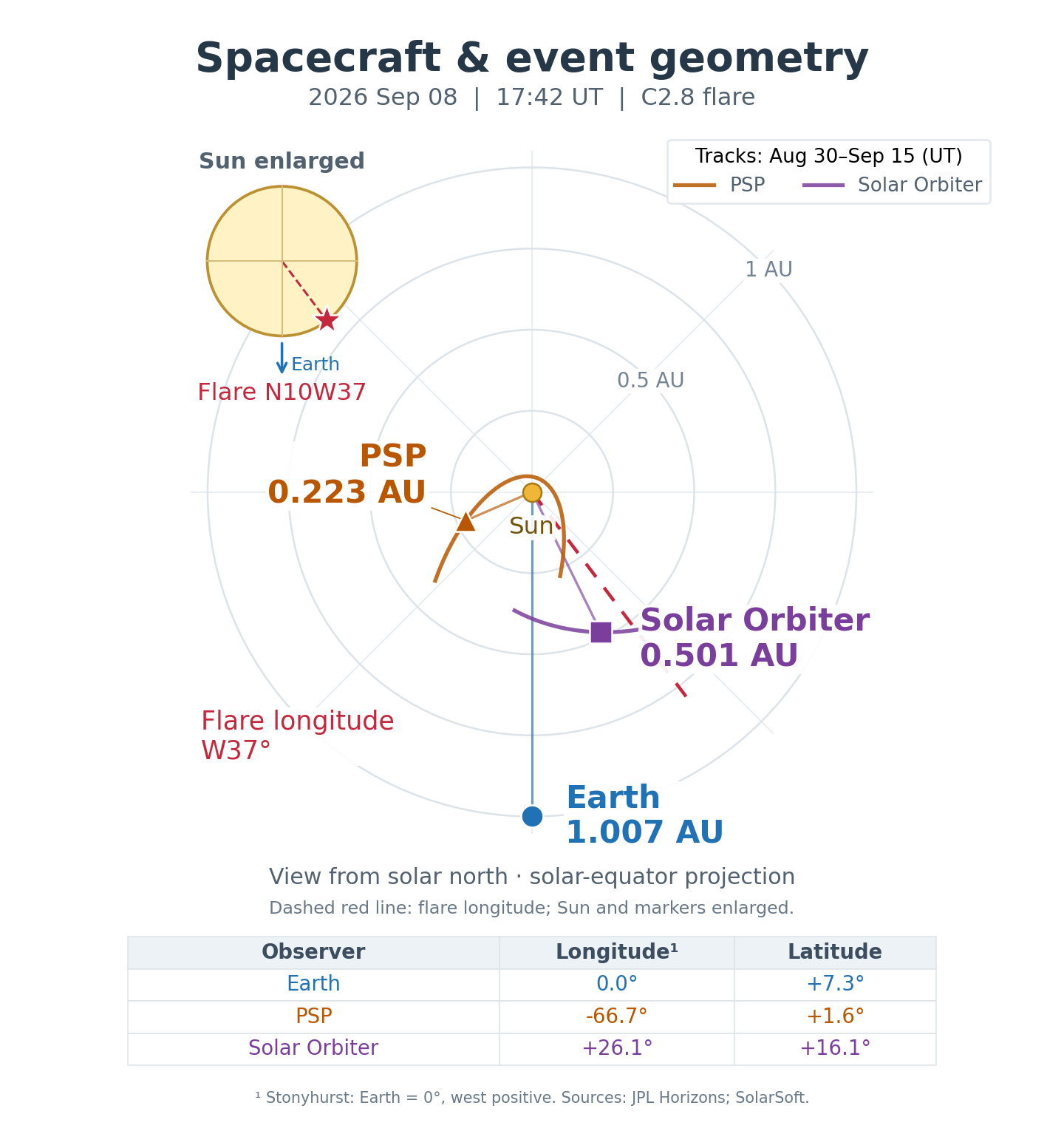 Geometry at 17:42 UT. C2.8 flare at N10W37. Solar-north view; spacecraft positions projected onto the solar equator. Inset: enlarged Sun. Full-size plot · Positions: JPL Horizons; Flare: SolarSoft. | EOVSA: Meiqi Wang |
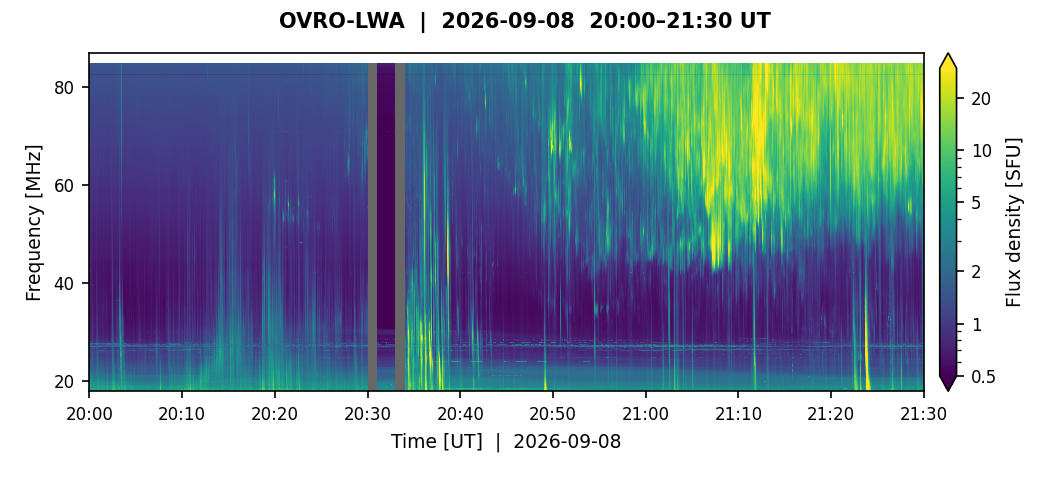
2026 Sep 08 | OVRO-LWA observed a type IV radio burst located at the east limb (OVRO-LWA imaging). The event is potentially associated with a GOES C1.2-class flare at S12E49 and a filament eruption. | Weak or no microwave signal. | Weak or no microwave signal. |
|  Stokes I spectral-image preview (20:58:09 UT) · Play movie · Download fine-channel HDF5 data (18.17–86.70 MHz; Typical cadence: ≈20–30 s; 180 spectral channels at 0.383 MHz resolution; 10 s integrations) | 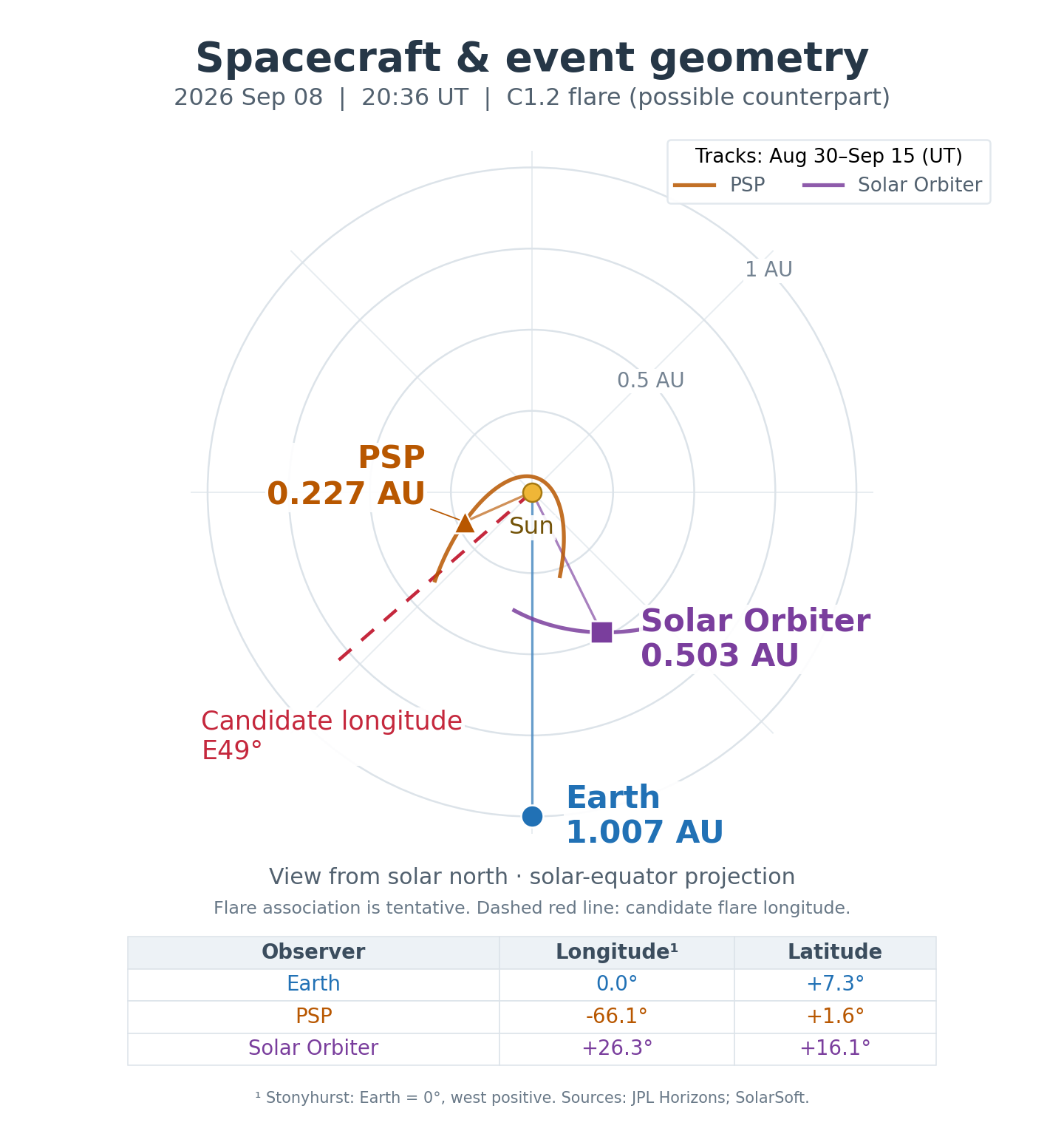 Geometry at 20:36 UT. Possible C1.2 flare counterpart at S12E49; association is tentative. Solar-north view; spacecraft positions projected onto the solar equator. Full-size plot · Positions: JPL Horizons; Flare: SolarSoft. |
OVRO-LWA: Peijin Zhang SoD: Meiqi Wang |
2026 Sep 08 | A GOES C2.6-class impulsive flare. EOVSA observed multiple microwave bursts. OVRO-LWA observed a group of type III radio bursts originating from the western hemisphere. AIA imaging shows a jet directed toward the west. |  Cross-power preview · Download FITS data: Total-power · Cross-power (1.1–18.0 GHz; Sampling: 1.0 s, 0.011–0.041 GHz within bands) | 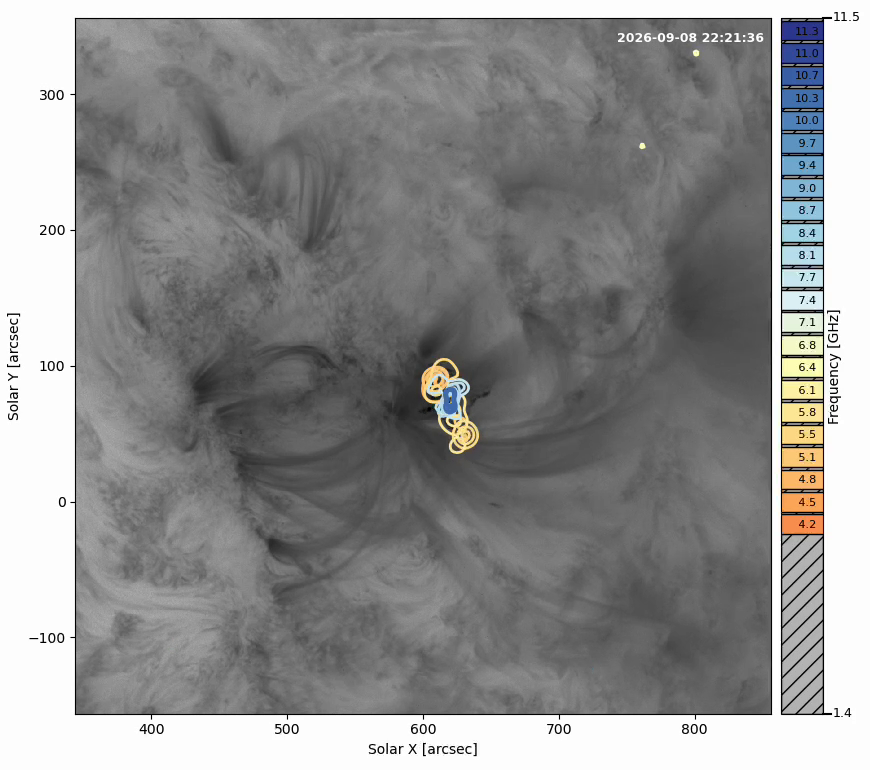 Spectral-image preview · Play movie · Download FITS data (4.17–11.32 GHz; Sampling: 4 s, 23 spectral channels at ≈0.325 GHz spacing) Antennas used for imaging: 1, 3, 4, 5, 6, 8, 9, 10, 11. |
|  Stokes I spectral-image preview (22:21:04 UT) · Play movie · Download fine-channel HDF5 data (18.17–86.70 MHz; Typical cadence: ≈20–30 s; 180 spectral channels at 0.383 MHz resolution; 10 s integrations) | 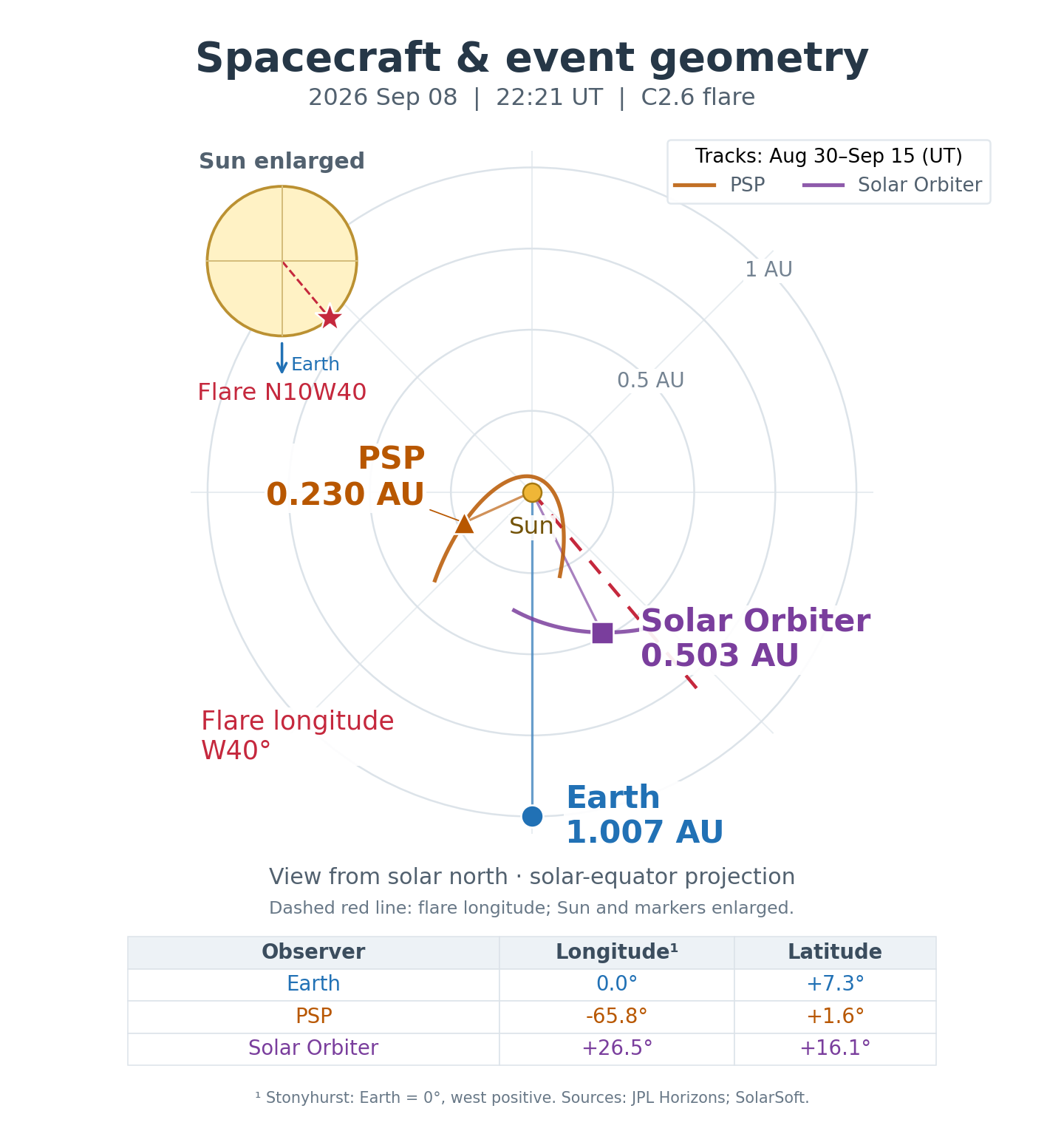 Geometry at 22:21 UT. C2.6 flare at N10W40. Solar-north view; spacecraft positions projected onto the solar equator. Inset: enlarged Sun. Full-size plot · Positions: JPL Horizons; Flare: SolarSoft. | EOVSA: Meiqi Wang |
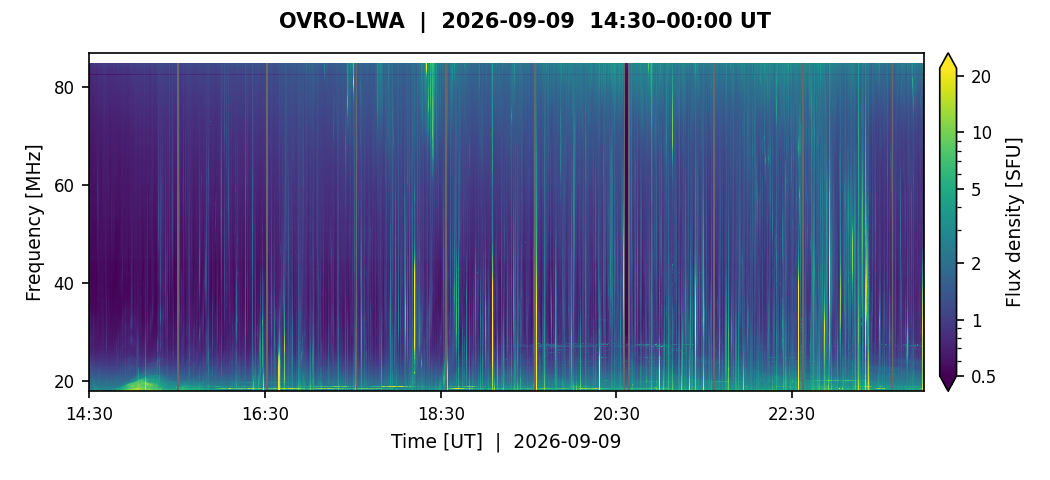
2026 Sep 09 | OVRO-LWA observed a type III solar storm lasting throughout the day, with polarized type III bursts at 16:39 UT, 18:34 UT, 19:06 UT, and 23:21 UT. Imaging at 39 and 75 MHz was interrupted from 14:40 to 16:20 UT; beamformer recording continued. | Weak or no microwave signal. No EOVSA coverage at 15:01–15:46 UT or during calibration, including the 18:34 UT burst. | Weak or no microwave signal. |
|  Stokes I spectral-image preview (19:05:25 UT) · Play movie · Download fine-channel HDF5 data (18.17–86.70 MHz; Typical cadence: ≈20–30 s; 180 spectral channels at 0.383 MHz resolution; 10 s integrations) | 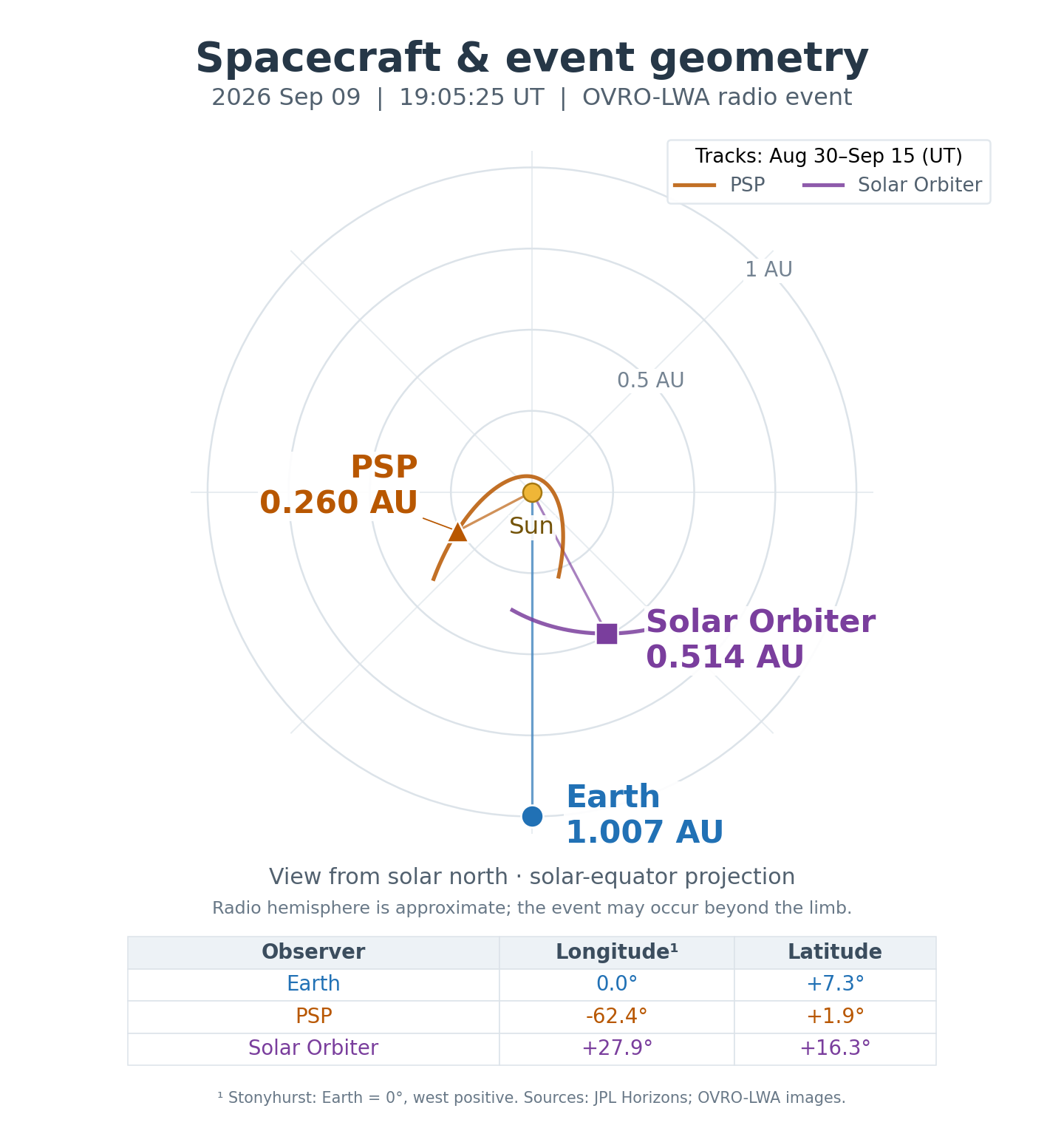 Representative geometry at 19:05:25 UT. No identified X-ray counterpart. OVRO-LWA image: southwestern hemisphere (projected). The event may occur beyond the limb. Solar-north view; spacecraft positions projected onto the solar equator. No precise flare longitude is assigned. Full-size plot · Positions: JPL Horizons; Radio location: OVRO-LWA image (19:05:25 UT). |
OVRO-LWA: Peijin Zhang SoD: Louis Seyfritz |
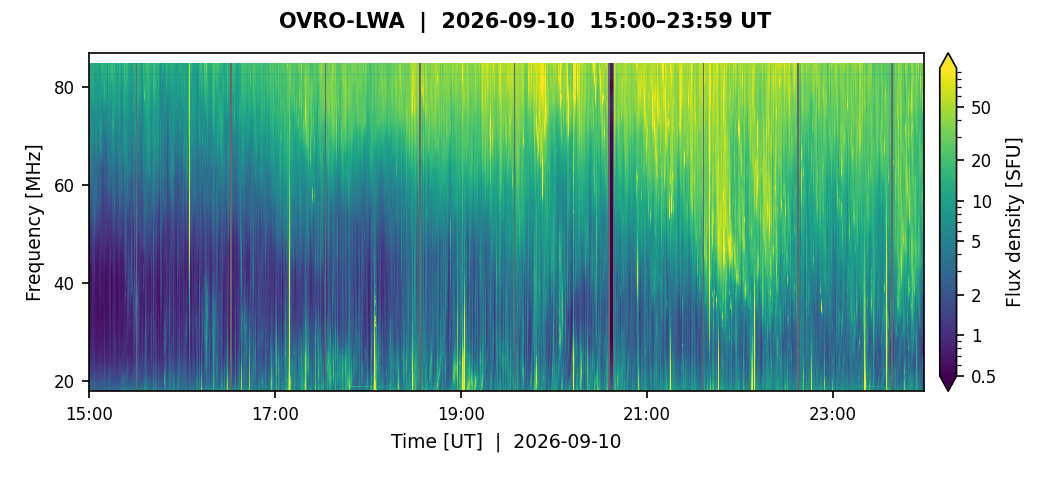
2026 Sep 10 | OVRO-LWA observed a type I noise storm from 15:00 to 23:59 UT, present throughout the day. EOVSA detected weak or no microwave signal during available coverage. | Weak or no microwave signal. No EOVSA coverage at 15:00 UT; solar observations resumed at 15:14 UT. Later coverage includes calibration gaps. | Weak or no microwave signal. |
|  Stokes I spectral-image preview (19:04:12 UT) · Play movie · Download fine-channel HDF5 data (18.17–86.70 MHz; Typical cadence: ≈20–30 s; 180 spectral channels at 0.383 MHz resolution; 10 s integrations) | 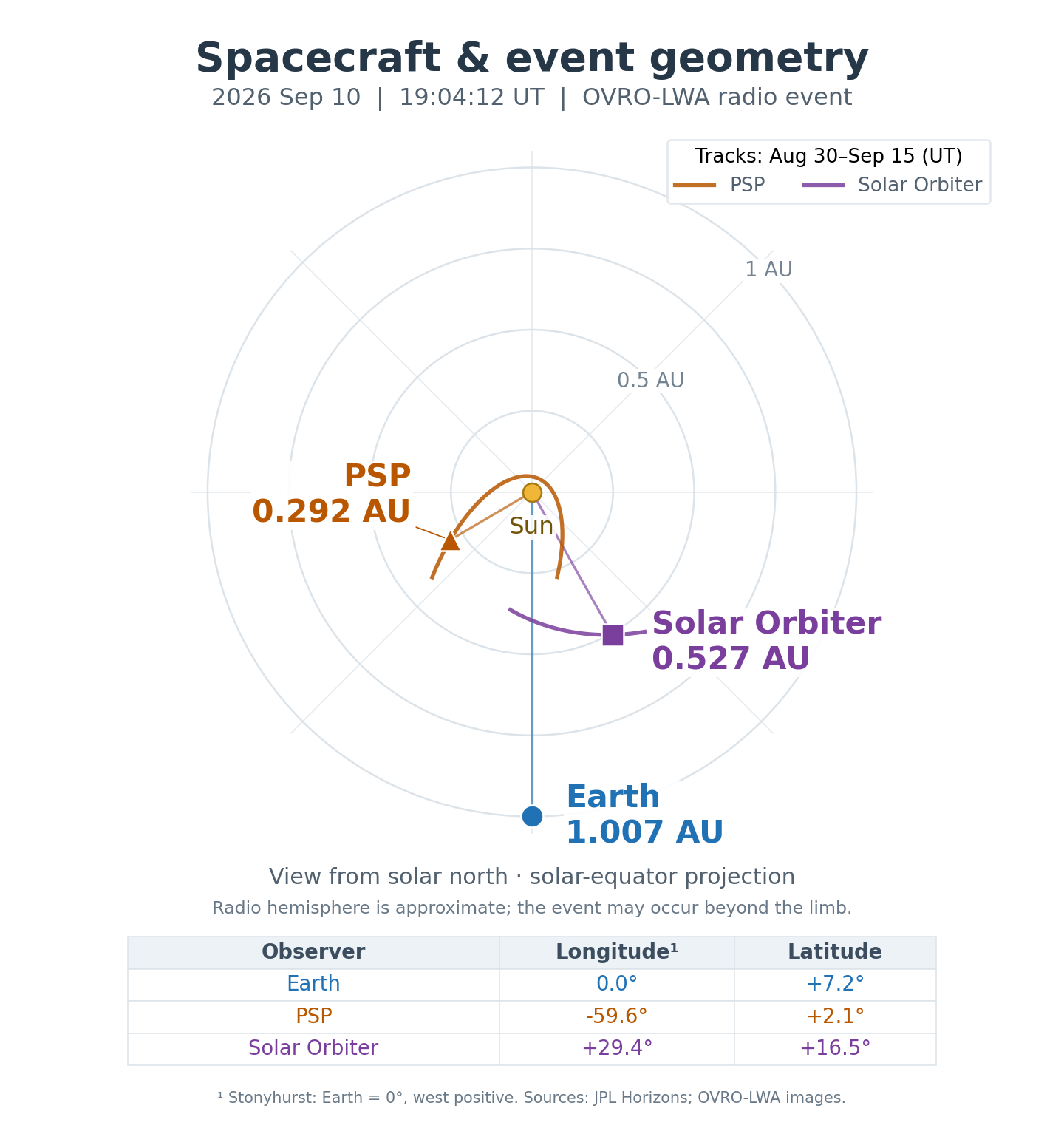 Representative geometry at 19:04:12 UT. No identified X-ray counterpart. OVRO-LWA image: southeastern hemisphere (projected). The event may occur beyond the limb. Solar-north view; spacecraft positions projected onto the solar equator. No precise flare longitude is assigned. Full-size plot · Positions: JPL Horizons; Radio location: OVRO-LWA image (19:04:12 UT). | OVRO-LWA: Peijin Zhang SoD: Louis Seyfritz |
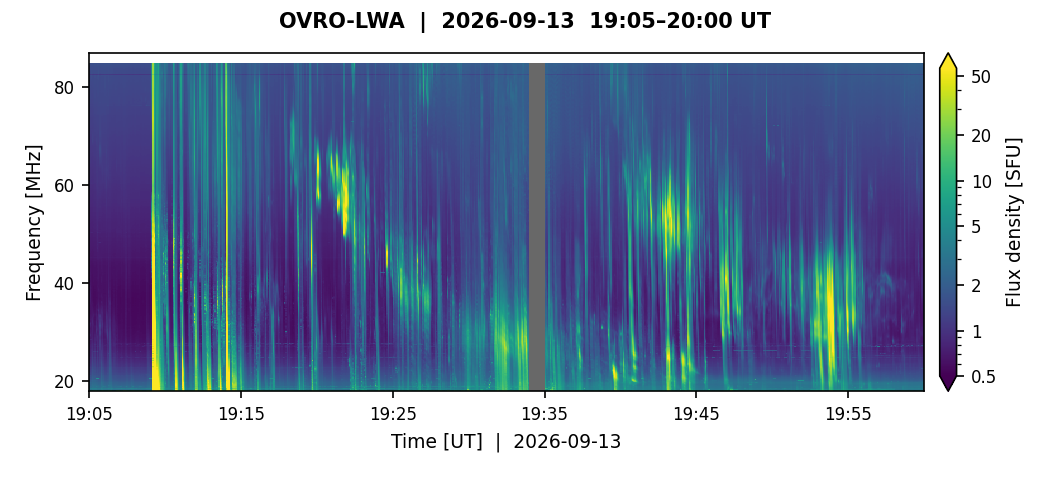
2026 Sep 13 | OVRO-LWA observed a bright metric complex group of type III bursts followed by a diffuse type IV burst with type-II-like fine structures. The bursts are associated with a CME. | Weak or no microwave signal. | Weak or no microwave signal. |
|  Stokes I spectral-image preview (19:09:14 UT) · Play movie · Download fine-channel HDF5 data (18.17–86.70 MHz; Typical cadence: ≈20–30 s; 180 spectral channels at 0.383 MHz resolution; 10 s integrations) | 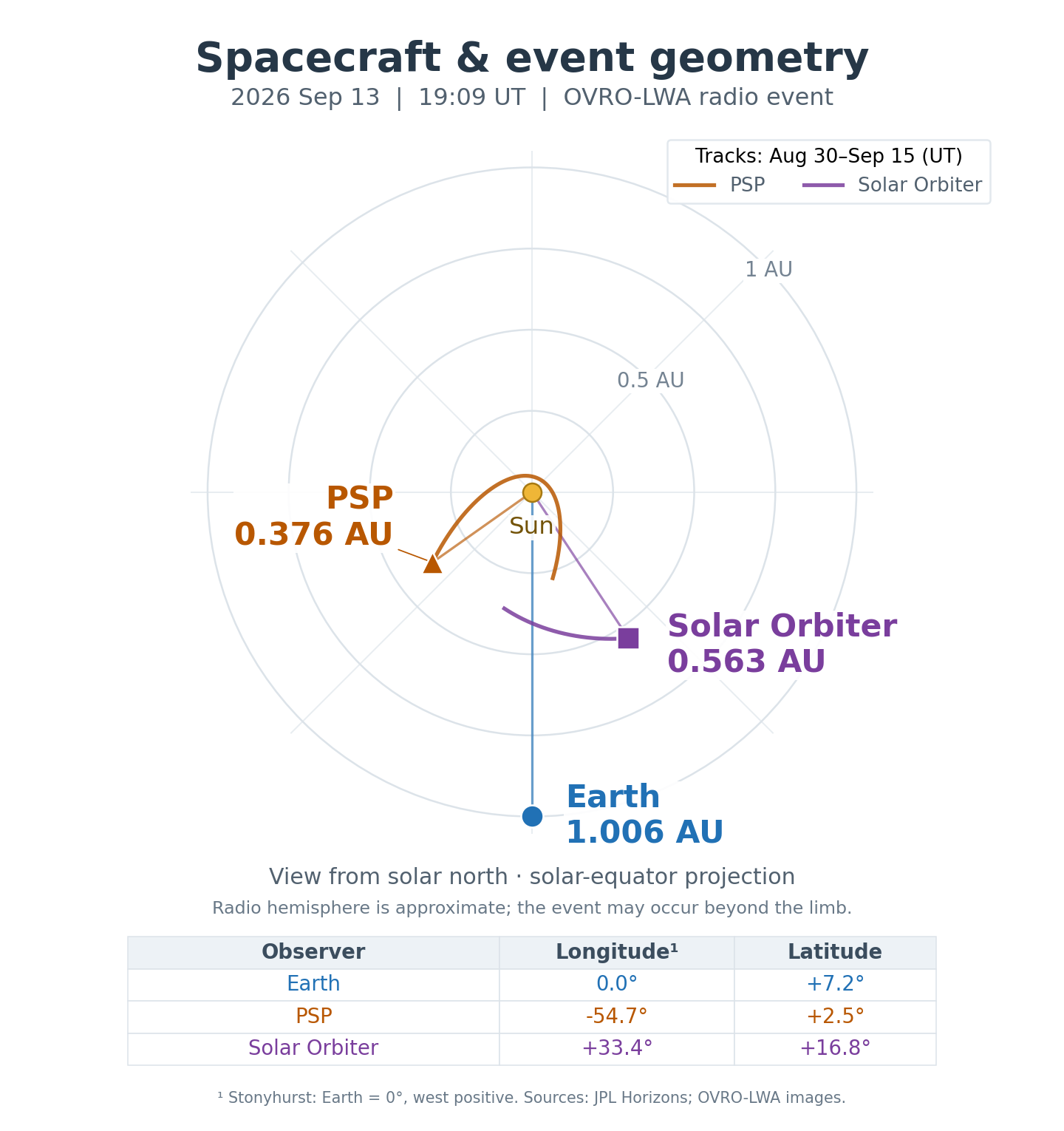 Geometry at 19:09 UT. No identified X-ray counterpart. OVRO-LWA image: southern hemisphere near disk center, slightly west (projected). The event may occur beyond the limb. Solar-north view; spacecraft positions projected onto the solar equator. No precise flare longitude is assigned. Full-size plot · Positions: JPL Horizons; Radio location: OVRO-LWA image (19:09:14 UT). |
OVRO-LWA: Peijin Zhang SoD: Anshika Singh |

Data access
The spectrogram previews and movies on this page are public. Each event row links to the data files for that event; the notes below explain how to download and read them. All dates and times are UT.
EOVSA
- Sign-in: EOVSA FITS downloads need a free access link sent by email. In the EOVSA Data Browser, click Email download access, enter your email, name, institution and intended use, complete the verification, and click Send Access Link. Open the link in the email (check Spam if it does not arrive). A FITS link clicked while signed out opens the same form.
- Spectrograms: the Total-power and Cross-power FITS links below each
cross-power preview download the event’s total-power (TP) and cross-power (XP)
dynamic spectra, respectively. Each link downloads one file. The primary array
holds the spectrum; HDU 1 lists the frequencies in GHz (
FGHZ) and HDU 2 the times as Julian dates (TIME). All TP and XP spectrogram FITS files linked here read as frequency × time arrays in Astropy/NumPy:spec.shape == (len(freq_ghz), len(time_jd)). - Images: the “Download FITS data” link in the spectral-images
column opens the event’s file listing, grouped by processing level and cadence:
- Primary 4 s Level 1.5 products:
eovsa.lev1p5_mbd_4s.YYYY-MM-DDThhmmssZ.image.fits. These are the products described by the event captions, with up to 39 frequency planes per cube. The HDU 1 header gives the restoring beam (BMAJ,BMIN,BPA). - Earlier 12 s products: some listings also contain
Level 1.5 files (
eovsa.lev1p5_mbd_12s.…image.fits) and pipeline Level 1 files (eovsa.lev1_mbd_12s.…image.fits; five events). In Level 1 files, each plane’s beam is in the HDU 2 table (bmaj,bmin,bpa).
eovsa.<level>_mbd_<cadence>.<start time>.image.fits, withlev1for Level 1 andlev1p5for Level 1.5. Spectral-image cubes hold brightness temperature in K (HDU 1: frequency × y × x, with 512 × 512 helioprojective pixels per plane) and the centre frequencies in Hz in HDU 2 (cfreqs). The same listings are in the Data Browser: choose the date, click Flares, and use the event’s row. - Primary 4 s Level 1.5 products:
- Visibilities: five of the six listings also hold the event’s
calibrated and self-calibrated visibilities as CASA measurement sets
(
<flare_id>.calibrated.ms.tar.gzand<flare_id>.selfcalibrated.ms.tar.gz, 0.2–2.9 GB each). - Bulk image downloads: for large image sets, use the listing’s
Download the FITS images of this folder as one tar form. Select a UTC
time-range preset or enter start and end times (end time excluded), then click
Request tar. When preparation finishes, use the download link.
The archive includes the selected FITS files, a
README.txt, andMD5SUMS. Split long intervals if they exceed the size limit shown in the form; the form also displays the tar-request limits. - Individual download limits: each user may download 20 files per minute and 500 per day; opening a listing counts as one request. The listings show current file counts. For large image sets, use the tar option above rather than requesting every FITS file individually.
Reading the files with Python and Astropy:
from astropy.io import fits
h = fits.open('eovsa.lev1p5_mbd_4s.2026-09-05T174059Z.image.fits')
cube = h[1].data                  # (frequency, y, x), brightness temperature in K
freqs = h[2].data['cfreqs']       # centre frequency of each plane, Hz
beam = h[1].header['BMAJ'], h[1].header['BMIN']   # Level 1.5 beam, degrees
# Level 1 files: per-plane beams in h[2].data['bmaj'], ['bmin'], ['bpa']
h.close()

s = fits.open('eovsa.spec_tp.flare_id_202609021926.fits')
spec = s[0].data                  # TP and XP: (frequency, time)
freq_ghz = s[1].data['FGHZ']
time_jd = s[2].data['TIME']
s.close()
OVRO-LWA
- No sign-in: all OVRO-LWA files linked here are public.
- Spectrograms: the “FITS” link downloads the whole
day’s beamformed spectrum, 0.7–0.9 GB per file and about
15–85 MHz; the preview on this page shows only the event interval. The
primary array holds the spectrum in Jy; the
SFREQtable gives the frequencies (GHz) and theUTtable the times (mjdandtime, milliseconds of the day). - Spectral images (HDF5): the “Download fine-channel HDF5 data” link
opens that day’s folder (
hdf_slow_lev1/YYYY/MM/DD/). Chooseovro-lwa-352.lev1_fch_10s.YYYY-MM-DDTHHMMSSZ.image_I.hdffor Stokes I fine-channel images: 180 channels spanning 18.17–86.70 MHz at 0.383 MHz spectral resolution (about 24–40 MB per file). These are 10 s integrations, typically spaced by 20–30 s; several 3–4 September intervals also have frequent 10 s spacings. Sampling is irregular and longer gaps occur, so check the file timestamps andDATE-OBSvalues for the interval being used. The thumbnails and movies show selected broad-band images; the caption sampling and channel counts describe the fine-channel data. Broad-band Stokes I and V files (ovro-lwa-352.lev1_mfs_10s.YYYY-MM-DDTHHMMSSZ.image_I.hdfand…image_V.hdf, about 3 MB each) are in the same folder. Pick the files whose times fall inside the event interval. Thelwa-solar-utilpackage reads them and converts them to FITS; see the OVRO-LWA product guide. - Bulk download: for example, all Stokes I fine-channel images from
19:26 to 19:33 UT on 3 September (20 files):
wget -r -l1 -np -nd -e robots=off \
  -A 'ovro-lwa-352.lev1_fch_10s.2026-09-03T192[6-9]*Z.image_I.hdf,ovro-lwa-352.lev1_fch_10s.2026-09-03T193[0-3]*Z.image_I.hdf' \
  'https://sprg.ssl.berkeley.edu/data/ovsa-lwa/hdf_slow_lev1/2026/09/03/'
Change the date, the time patterns, andmfs/fchorI/Vfor another interval or product. - Ionospheric refraction: The Level 1 HDF5 images linked here have not been corrected for ionospheric refraction, which can cause frequency-dependent shifts in apparent source positions. When the quiet-Sun disk is visible, follow the quiet-Sun correction procedure and worked example: convert the HDF5 cube to FITS, estimate the disk-centre offsets, fit their approximately 1/ν2 frequency dependence, and apply the correction. When only burst emission is visible, the experimental manual correction tool allows interactive adjustment of these shifts. Evaluate manual corrections carefully to avoid removing genuine frequency-dependent source structure.
More data and help
Availability, frequency coverage, cadence, and calibration vary among products, and OVRO-LWA beamformer and imaging coverage should be checked separately: one may be available when the other is not. For visibilities, custom processing, or products not linked here, submit an OVSA Data Request or contact the OVSA team.
Credits, Acknowledgements, and Disclaimers
The campaign was led by OVSA Principal Investigator Bin Chen. Sijie Yu, EOVSA Project Scientist, and Peijin Zhang, OVRO-LWA Solar Project Scientist, oversaw the performance of the respective instruments.
We thank the OVSA observatory staff, Owen Giersch and Caius Selhorst, and the scientists-on-duty who supported the campaign during 2–13 September 2026: Mallory Wickline, Meredith Wieber, Ivan Oparin, Meiqi Wang, Louis Seyfritz, and Anshika Singh. We also thank the other OVRO staff and the OVRO-LWA team for their support.
SDO/AIA observations are courtesy of NASA/SDO and the AIA science team. We thank NOAA for the GOES/XRS observations and the SOHO/LASCO consortium for the coronagraph observations. SOHO is a project of international cooperation between ESA and NASA. CME information was obtained from the CACTus catalogue, maintained by SIDC at the Royal Observatory of Belgium. We acknowledge LMSAL for its SolarSoft Latest Events, AIA cutout/movie, and Heliophysics Event Knowledgebase services, and NASA/JPL for the Horizons spacecraft ephemerides.
Radio-data processing made use of CASA and WSClean. Spacecraft-geometry calculations and visualization used SunPy, Astropy, NumPy, and Matplotlib. We thank the developers and maintainers of these software packages.
Publications using these data should follow the OVSA Data Policy for instrument citations, acknowledgements, and authorship guidance.
The PSP Encounter 29 observing campaign and preparation of its supporting data products were supported by NASA’s PSP Data Support award 80NSSC26K1200. EOVSA was designed, built, and is now operated by the New Jersey Institute of Technology (NJIT) as a community facility. The OVRO-LWA expansion project was supported by NSF under grant AST-1828784. EOVSA and OVRO-LWA solar operations are supported by NSF grant AGS-2436999 to NJIT.
The views expressed here are those of the contributors and do not necessarily reflect those of NSF or NASA.