Owens Valley Solar Arrays
Owens Valley Solar Arrays (OVSA) is a university-led radio facility dedicated to solar astrophysics and space weather research. Located in the Owens Valley Radio Observatory (OVRO) near Big Pine, California, the operations of OVSA include the Expanded Owens Valley Solar Array (EOVSA) observing in the microwave regime (1-18 GHz), as well as the solar and space weather aspects of the newly commissioned Long Wavelength Array at the Owens Valley Radio Observatory (OVRO-LWA), which observes in the meter-decameter wavelength regime (13-87 MHz). Please refer to our home page for more general descriptions of the facility. This wiki serves as the site for OVSA documentation.
Operation of OVSA is supported by the National Science Foundation under Grant AGS-2436999. Any opinions, findings, and conclusions or recommendations expressed in this material are those of the author(s) and do not necessarily reflect the views of the National Science Foundation. |

|
Latest OVSA Science Highlights
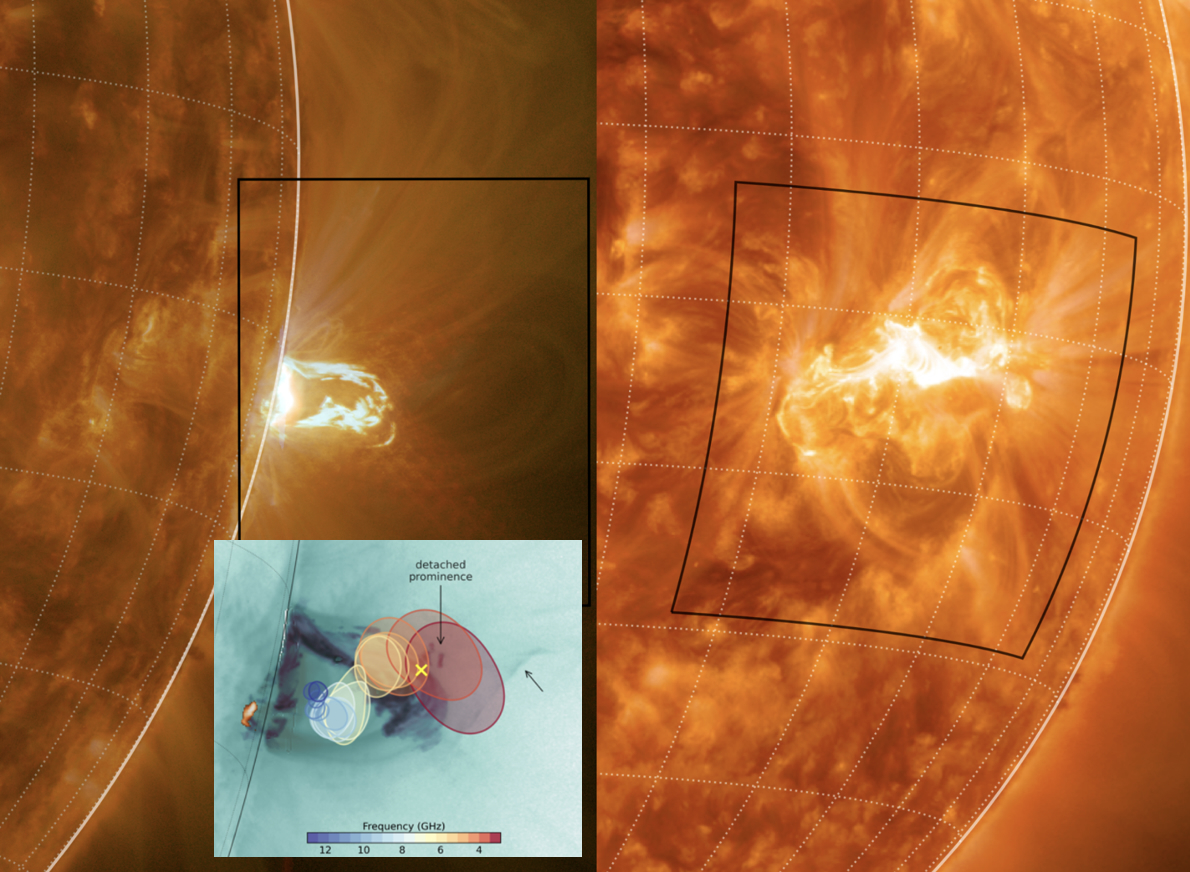
EOVSA imaged two coherent microwave bursts from energetic electrons near the front of a rising magnetic flux rope. Together with multiwavelength observations, the radio sources support a picture in which magnetic erosion and strong overlying fields helped halt the eruption. [Contributed by Tingyu Gou (Center for Astrophysics | Harvard & Smithsonian); Edited by Sijie Yu. Posted on August 15, 2026.]
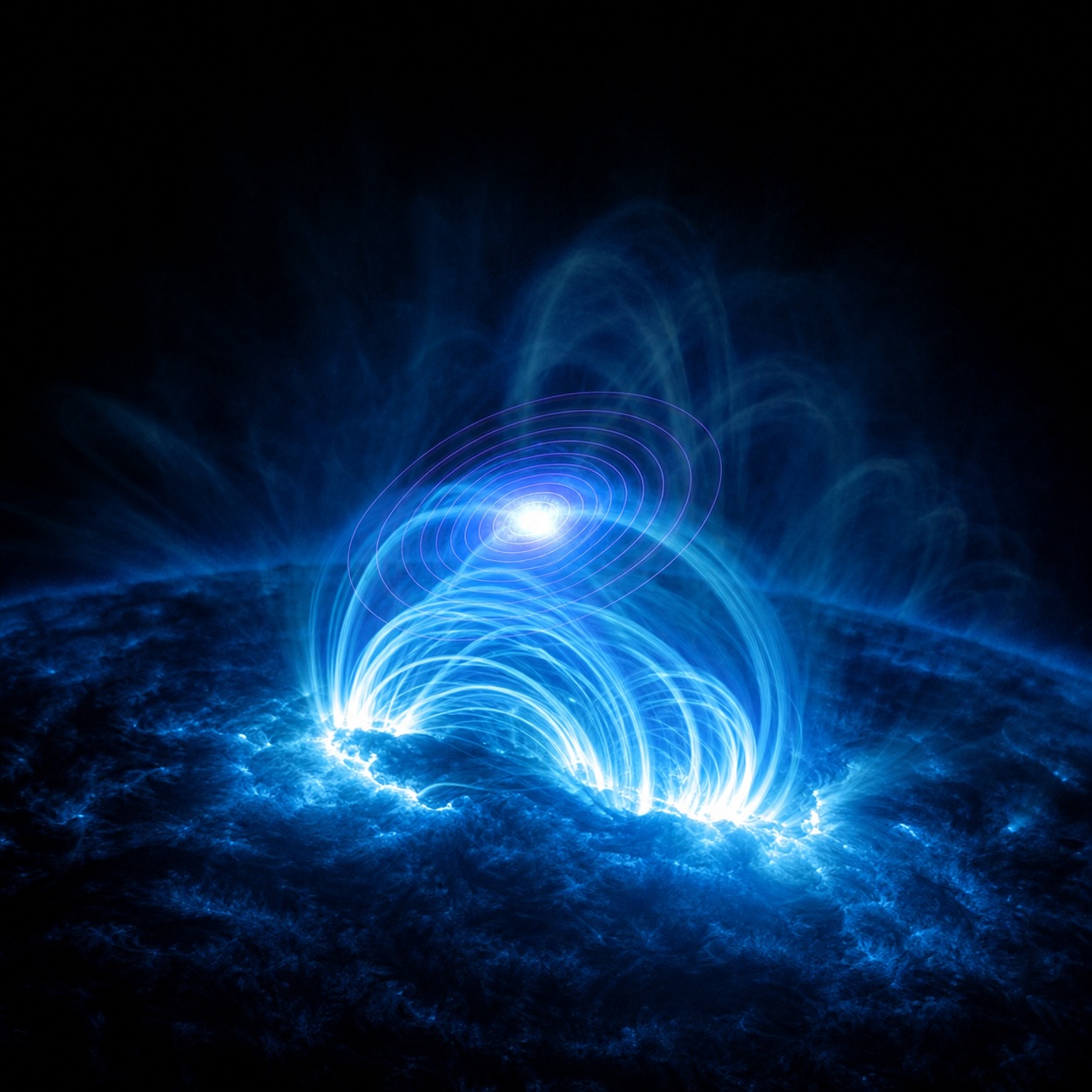
Using EOVSA microwave imaging spectroscopy, researchers mapped the rapidly weakening coronal magnetic field in an X-class solar flare and linked it to the rise of energetic electrons in the flare arcade. [Contributed by Gregory D. Fleishman (New Jersey Institute of Technology); Edited by S. Yu Posted on May 11, 2026.]
Using microwave imaging spectroscopy data from EOVSA combined with in situ measurements, researchers have shed light on the mystery of missing energetic electrons entering interplanetary space [Contributed by Meiqi Wang (New Jersey Institute of Technology); Edited by B. Chen. Posted on April 30, 2026.]
By integrating EOVSA microwave imaging spectroscopy with stereoscopic soft X-ray observations for 3D reconstruction, researchers have measured key plasma parameters in a solar flare arcade. [Contributed by Tatyana Kaltman (Institut für Sonnenphysik (KIS)); Edited by S. Yu. Posted on April 30, 2026.]

A new study published in Nature Astronomy reveals the location and extent of a distinct group of extremely energetic electrons in a large solar flare. Their energies peak at a few million electron volts—several times higher than the rest-mass energy of electrons. [Contributed by Gregory Fleishman (New Jersey Institute of Technology); Edited by B. Chen. Posted on Jan 30, 2026.]
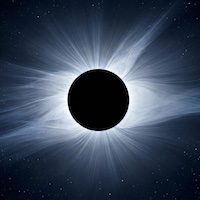
Mysterious weak radio emission is observed by OVRO-LWA in the Sun's middle corona during quiescent times. According to this study, it is produced by nonthermal electrons. [Contributed by Surajit Mondal (New Jersey Institute of Technology); Edited by B. Chen. Posted on Jan 30, 2026.]
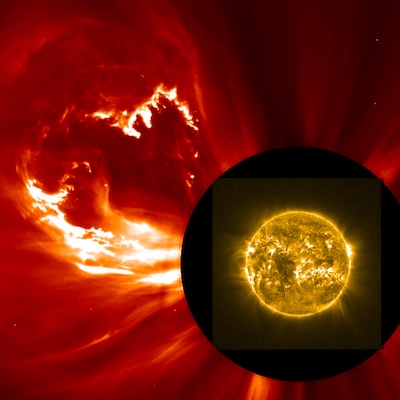
This study reports the first possible detection of thermal gyroresonance emission from a CME. This breakthrough offers a new potential method for measuring the magnetic field of CMEs. [Contributed by Surajit Mondal (New Jersey Institute of Technology); Edited by B. Chen. Posted on September 26, 2025.]
We welcome contributions at all times. Please refer to the OVSA Science Highlights page for author guidelines and a complete list of highlights.
OVSA Publications
Our collection of publications that utilize OVSA data is available at this NASA/ADS Library. If you have a paper that is missing from this library, please email Bin Chen (bin.chen [at] njit.edu).
EOVSA Flare List
- Query EOVSA Flare list
- List of EOVSA flares in separate years: 2026, 2025, 2024, 2023, 2022, 2021, 2020, 2019, 2017
Highlighted EOVSA Events
The following are fully calibrated spectral image FITS files prepared by EOVSA team members. They are ready for quantitative spectral imaging analysis. Please credit the provider(s) if you use them for your work, following our data policy.
- 2017 September 10 flare [Credit: Bin Chen]
- Fully calibrated FITS spectral image files: Standard FITS files in Helioprojective Cartesian Coordinates. 15:48-16:16 UT; 30 frequencies per image cube; 4-s cadence.
- Calibrated visibility data with full spectral-temporal resolution: Calibrated and self-calibrated visibility data from 15:46-16:16 UT. It is in CASA's measurement set format, containing 134 frequencies from 2.9 to 17.9 GHz with full 1-s cadence. (The one with "slfcaled" in the name indicates selfcalibrated images).
OVSA Observing
OVSA Weekly Observing Reports
Here is the directory to all weekly reports.
- 2026
- Q2: 03/30-04/05, 04/06-04/12
- Q1: 12/23-01/04, 01/05-01/11, 01/12-01/18, 01/19-01/25, 01/26-02/01, 02/02-02/08, 02/09-02/15, 02/16-02/22, 02/23-03/01, 03/02-03/08, 03/09-03/15, 03/16-03/22, 03/23-03/29
- 2025
- Q4: 09/30-10/06, 10/07-10/13, 10/14-10/20, 10/21-10/27, 10/28-11/03, 11/04-11/10, 11/11-11/17, 11/18-11/24, 11/25-12/01, 12/02-12/08,12/09-12/15, 12/16-12/22
- Q3: 08/26-09/01, 09/02-09/08, 09/09-09/15, 09/16-09/22, 09/23-09/29
OVSA Scientist on Duty
- Scientist on Duty (SoD): OVSA team members take turns and serve as a SoD to work with our onsite observatory staff on day-to-day observing. They are also responsible for monitoring solar activities and ensuring that the data we collect is of high quality.
- SoD observing logs (directory to all logs):
- 2026: January, February, March,April, May
- 2025: January, February, March, April, May, June, July, August, September, October, November, December
- 2024: May (and before that), June, July, August, September, October, November, December
- SoD instructions:
- Daily routines: see SoD Routines for detailed instructions.
- Instructions for making quick-look flare spectrograms and images
EOVSA Observing Log
2017 January; February; March; April; May; June; July; August; September; October; November; December
2018 January; February; March; April; May; June; July; August; September; October; November; December
2019 January; February; March; April; May; June; July; August; September; October; November; December
2020 January; February; March; April; May; June; July; August; September; October; November; December
2021 January; February; March; April; May; June; July; August; September; October; November; December
2023 January; February; March; April; May; June; July; August; September; October; November; December
2024 January; February; March; April; May; June; July; August; September; October; November; December
2025 January; February; March; April; May; June; July; August; September; October; November; December
2026 January; February; March; April; May; June; July; August; September; October; November; December
Using OVSA Data
- EOVSA Data Products: An introduction to standard EOVSA spectrogram and spectral image products with example scripts for reading and plotting.
- OVRO-LWA Solar Data Products: An introduction to OVRO-LWA solar spectrogram and spectral image products with example scripts for reading and plotting.
- OVSA Data Policy: Policy for using OVSA data products.
- Analysis Software: These are for in-depth use of EOVSA data (from calibrated visibilities) and tools for quantitative analysis.
- SunCASA A wrapper around CASA (the Common Astronomy Software Applications package) for synthesis imaging and visualizing solar spectral imaging data. CASA is one of the leading software tool for "supporting the data post-processing needs of the next generation of radio astronomical telescopes such as ALMA and VLA", an international effort led by the National Radio Astronomy Observatory. The current version of CASA uses Python (2.7) interface. More information about CASA can be found on NRAO's CASA website. Note, CASA is available ONLY on UNIX-BASED PLATFORMS (and therefore, so is SunCASA).
- GSFIT A IDL-widget(GUI)-based spectral fitting package called gsfit, which provides a user-friendly display of EOVSA image cubes and an interface to fast fitting codes (via platform-dependent shared-object libraries).
- pyGSFIT A Python-widget(pyQT)-based spectral fitting package, which provides a user-friendly display of EOVSA image cubes, spatially resolved spectra, and an interface to scipy-based fitting codes.
- Spectrogram Software
- Mapping Software
- Data Analysis Guides (for those who start from raw data)
-
- Tohban Guide to Self Calibration and Imaging for EOVSA Step-to-step guide for manually making images from raw visibility data.
- EOVSA flare pipeline Description of the EOVSA flare pipeline and tutorial for running it to produce quicklook images.
- EOVSA Modeling Guide
- GX Simulator
- Other helpful links
- CASA Guides
- SolarSoft IDL
- Miriad Guides
- Fast Gyrosynchrotron Codes (Alexey Kuznetsov's website)
- Basic GitHub Tutorial
- Full Disk Simulations
- All-Day Synthesis Issues
- Analyzing Pre-2017 Data
- Fixing Pipeline Problems pre-2021-Feb-07
EOVSA Documentation
- General
- Downconversion and Frequency Tuning
- Dealing with Radio Frequency Interference
- Switching between 200 MHz and 300 MHz Correlator
- Observing in "Fast" Mode
- Computer-Network
- Computing Systems
- Network
- Control System
- 27-m Antenna Commands
- Schedule Commands
- Control Commands
- Attenuation and Level Control
- Hardware
- Hardware Overview
- 2.1-m Antennas
- 27-m Antennas
- System Software
- Calibration Database
- Stateframe Database
- Database Maintenance
- Create CASA measurement sets
- Calibration
- Calibration Overview
- Pointing Calibration
- Total Power Calibration
- System Gain Calibration
- Antenna Position (Baseline Calibration)
- Reference Gain Calibration
- Daily Gain Calibration
- Delay Calibration
- Bandpass Calibration
- Polarization Calibration
- Calibrator Survey
- Practical Calibration Tutorial
EOVSA System Software
- LabVIEW software
- Python code Github repository
- Python3 Code Installation
OVRO-LWA Solar-Dedicated Spectroscopic Imager
The OVRO-LWA (Owens Valley Radio Observatory Long Wavelength Array) has recently been upgraded to include a solar-dedicated beam and two solar imaging modes (slow visibilities of 352 antennas with a 10-s cadence, and fast visibilities of 48 antennas with a 0.1-s cadence). The large collecting area and excellent calibration provide unprecedented high-sensitivity imaging of the quiet Sun and bursts. The array is currently in commissioning and observations are not yet continuous, but they are becoming more so. See the daily realtime data at http://ovsa.njit.edu/status.php for real-time display of the spectrogram and a selection of images, both updated on a 1-min cadence.
Solar-Dedicated Modes
- Beamformer: The OVRO-LWA beamformer uses the 256 antennas in the core region to form a synthesized beam of more than 1 degree in size that tracks the Sun from sunrise to sunset. This permits a continuous record of the full-Stokes total flux (without spatial resolution) of the Sun (a dynamic spectrum) with 24 kHz frequency resolution (3072 frequencies from 13.4-86.9 MHz) and as low as 1 ms time resolution.
- Standard Interferometric Imaging (also known as "Slow Visibilities"): In this mode, the entire 352-element array is interferometrically correlated to provide visibilities for imaging at all 3072 frequencies at 10-s time resolution. This is ideal for imaging quiet Sun and slowly-varying emission such as coronal mass ejections and active region variability.
- Bursty Interferometric Imaging (also known as "Fast Visibilities"): In this mode, a subset of 48 antennas (chosen to include mainly outer antennas to maintain good spatial resolution) is interferometrically correlated to provide visibilities for imaging at 768 frequencies (96 kHz frequency resolution) at 0.1-s time resolution. This is ideal for imaging rapidly varying emission such as type II and type III bursts as well as many other solar spectral fine structures.
Data Access
- OVRO-LWA solar data release v1.0 is available! Please refer to the OVRO-LWA Data Products page for more information.
OVRO-LWA Operation Notes
Tohbans
Tohban EOVSA Imaging Tutorial A-Z
Tohban OVRO-LWA Imaging Tutorial
Tohban Guide to Self Calibration and Imaging for EOVSA
Guide to Upgrade SolarSoft(SSW)
VLA Flare List and Publications
See this link for a list of flare observations made by the Karl G. Jansky Very Large Array (VLA). Below is a partial list of publications that utilize VLA solar data (see also this NASA/ADS Library).
- Luo et al. (2022), ApJ, 940, 137 Multiple Regions of Nonthermal Quasiperiodic Pulsations during the Impulsive Phase of a Solar Flare
- Battaglia et al. (2021), ApJ, 922, 134 Multiple Electron Acceleration Instances during a Series of Solar Microflares Observed Simultaneously at X-Rays and Microwaves
- Luo et al. (2021), ApJ, 911, 4 Radio Spectral Imaging of an M8.4 Eruptive Solar Flare: Possible Evidence of a Termination Shock
- Zhang et al. (2021), ApJ, 910, 40 Multiwavelength Observations of the Formation and Eruption of a Complex Filament
- Sharma et al. (2020), ApJ, 904, 94 Radio and X-Ray Observations of Short-lived Episodes of Electron Acceleration in a Solar Microflare
- Chen et al. (2019), ApJ, 884, 63 Radio Spectroscopic Imaging of a Solar Flare Termination Shock: Split-band Feature as Evidence for Shock Compression
- Yu & Chen (2019), ApJ, 872, 71 Possible Detection of Subsecond-period Propagating Magnetohydrodynamics Waves in Post-reconnection Magnetic Loops during a Two-ribbon Solar Flare
- Chen et al. (2018), ApJ, 866, 62 ''Magnetic Reconnection Null Points as the Origin of Semirelativistic Electron Beams in a Solar Jet
''
- Wang et al. (2016), ApJ, 848, 77 Dynamic Spectral Imaging of Decimetric Fiber Bursts in an Eruptive Solar Flare
- Chen et al. (2015), Science, 350, 1238 Particle acceleration by a solar flare termination shock
- Chen et al. (2014), ApJ, 794, 149 Direct Evidence of an Eruptive, Filament-hosting Magnetic Flux Rope Leading to a Fast Solar Coronal Mass Ejection
- Chen et al. (2013), ApJL, 763, 21 Tracing Electron Beams in the Sun's Corona with Radio Dynamic Imaging Spectroscopy
Radio Data from Around The Heliosphere
Radio Astronomy Lecture Notes
Here is a link to the Radio Astronomy Lecture Notes adapted from the Phys728: Radio Astronomy graduate-level course Prof. Dale Gary taught at NJIT until Spring 2019.
Migrated from MediaWiki page Owens Valley Solar Arrays, latest revision 15424 (2026-05-11T21:12:41Z).