OVSA Science Highlight No. 10: A Fresh Look at the "Missing in situ Electron" Problem
Contributed by Meiqi Wang1 (1Center for Solar-Terrestrial Research, New Jersey Institute of Technology, 323 Martin Luther King Jr Blvd., Newark, NJ 07102-1982, USA); Edited by B. Chen. Posted on April 30, 2026.
In solar energetic electron (SEE) events associated with flares, the number of escaping electrons into interplanetary space has been found to be very small, accounting for only ~0.1–1% of the total number produced (e.g., W. Wang et al. 2021). This deficiency in escaping electrons clearly deviates from the equipartition of upward- and downward-propagating populations—as one might expect if they are produced near the magnetic reconnection X point—and raises questions about where they are accelerated and how they (cannot) escape.
In this study, we took a fresh look at such an in situ SEE event observed jointly by the Solar Orbiter/EPD, WIND, and STEREO-A from different longitudes. The nonthermal flare signatures in hard X-rays (HXR) and microwaves were captured by Solar Orbiter/STIX and the Expanded Owens Valley Solar Array (EOVSA), respectively (Fig. 1).
Crucially, using microwave imaging spectroscopy, we were able to constrain spatially resolved electron spectra at the jet base. Our results suggest that the nonthermal electron density already decreases by about two orders of magnitude as they leave the presumed acceleration region above the mini-arcade and enter the open field (Fig. 2).
This observed signature is analogous to previous observations of major eruptive flares in which energetic electrons are accelerated and trapped in the above-the-looptop region, where a “magnetic bottle” structure is present (Chen et al. 2024). The closed-field geometry, combined with strong trapping, makes the escape of energetic electrons difficult, which accounts for the observed deficiency in the escaping electron population.
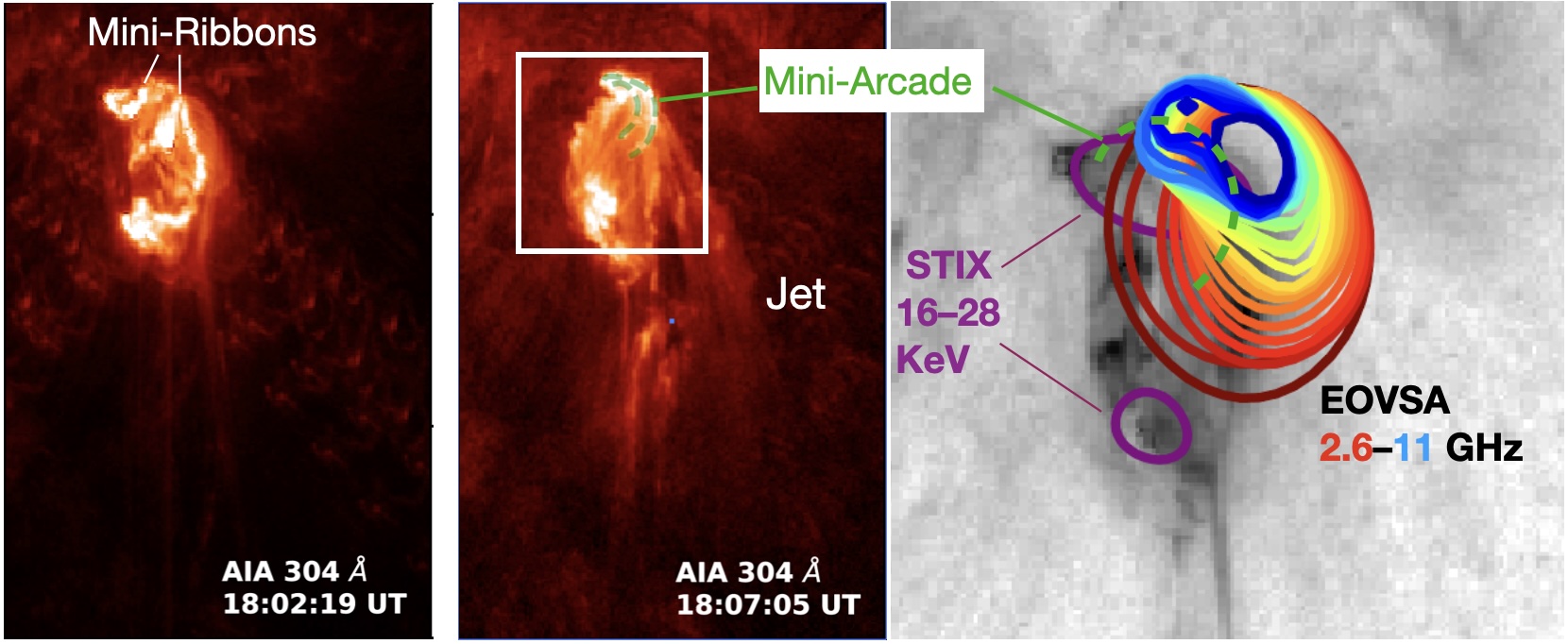
Fig. 1. SDO/AIA, SolO/STIX, and EOVSA observations of a solar jet featuring the eruption of a mini-filament. A multi-frequency microwave source is located above a mini-arcade at the jet base.
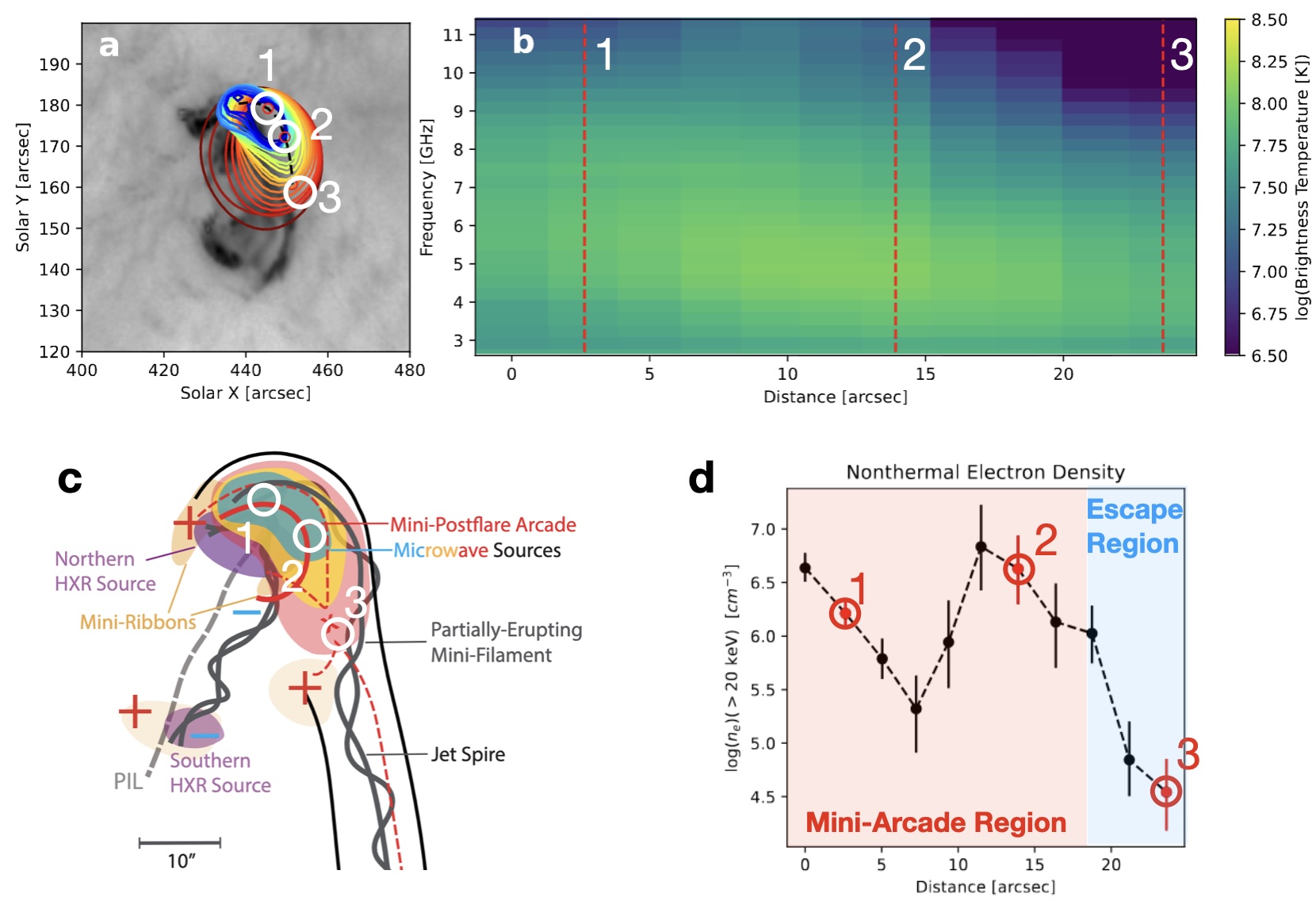
Fig. 2. Spatially resolved microwave spectroscopy reveals that the nonthermal electron density in the “escaping region” above the mini-arcade already drops by about two orders of magnitude compared to that in the mini-arcade region. It suggests that the observed deficiency of the escaping electrons into the interplanetary space is likely due to strong trapping in the above-the-arcade site.
Based on the recent paper by Meiqi Wang, Bin Chen, Mallory Wickline, Sijie Yu, Säm Krucker, Jeongwoo Lee, and Haimin Wang (2026), "Few Made It Out: A Multimessenger Study of an In Situ Solar Energetic Electron Event Driven by a Solar Jet," The Astrophysical Journal
Migrated from MediaWiki page OVSA Science Highlight No. 10: A Fresh Look at the "Missing in situ Electron" Problem, latest revision 15276 (2026-05-01T15:59:53Z).