OVSA Science Highlight No. 9: Inferring Alfvén Speed and Plasma Beta in 3D
Contributed by Tatyana Kaltman1 (11Institut für Sonnenphysik (KIS), Georges-Köhler-Allee 401 A, D-79110 Freiburg, Germany); Edited by S. Yu. Posted on April 30, 2026.
Measurements of the magnetic field in solar flares remain one of the major challenges in solar physics. Microwave imaging spectroscopy with the Expanded Owens Valley Solar Array (EOVSA) offers a unique way to diagnose the coronal magnetic field through gyrosynchrotron emission produced by energetic electrons accelerated in flares. These observations allow obtaining spatially resolved maps of the magnetic field and plasma parameters from the flare emission. However, microwave imaging alone provides only a two-dimensional projection of the source on the plane of the sky, leaving the position along the line of sight uncertain.
A recent paper published in Astronomy & Astrophysics combines EOVSA microwave imaging spectroscopy with stereoscopic soft X-ray observations to reconstruct the 3D structure of the 2021 May 7 M-class solar flare, observed jointly with EOVSA, Solar Orbiter/STIX, and Hinode/XRT.
The EOVSA data were used to derive spatially resolved maps of magnetic field strength and plasma parameters via gyrosynchrotron model spectral fitting. Stereoscopic observations of the soft X-ray source from two vantage points yielded a 3D reconstruction of the flare geometry. Because the microwave and X-ray emissions originate from the same plasma volume (Fig. 1), the stereoscopic X-ray reconstruction provides the missing line-of-sight information needed to place the microwave-derived parameters in their 3D locations. This analysis has provided the first observational reconstruction of the 3D distribution of the magnetic field and plasma parameters in the flaring volume.
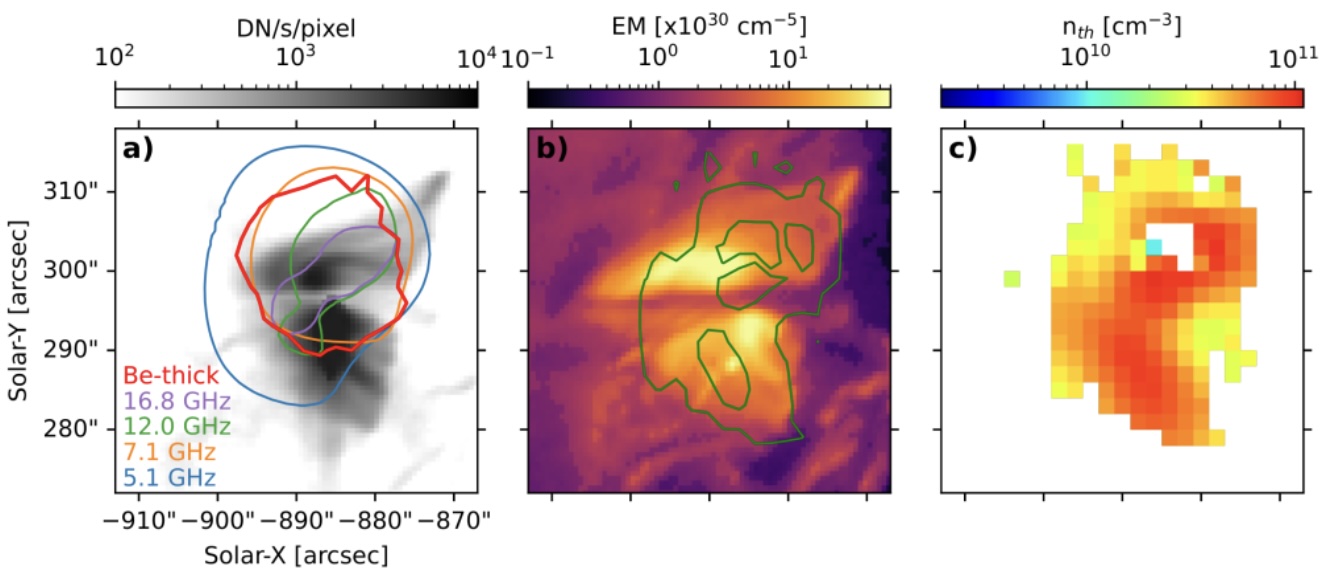
Fig. 1. Multiwavelength context of the 2021 May 7 solar flare. The AIA 94 Å image shows the flaring region, with contours indicating microwave sources observed with EOVSA at several frequencies and the soft X-ray source observed with Hinode/XRT. The emission measure derived from EUV observations closely matches the plasma density inferred from microwave spectral fitting, indicating that both emissions sample the same plasma.
The study reports the 3D distributions of magnetic field strength and plasma density in the flare and derives such key plasma parameters as the Alfvén speed and plasma beta. The results show that the flare region is magnetically dominated, with plasma beta remaining well below unity and Alfvén speed reaching several 10⁸ cm s⁻¹.
These 3D distributions provide important, earlier unavailable, observational constraints on the magnetic and plasma environment in solar flares needed for theoretical models of magnetic reconnection, flare energy release, and particle acceleration and in a broader context of coronal modeling.
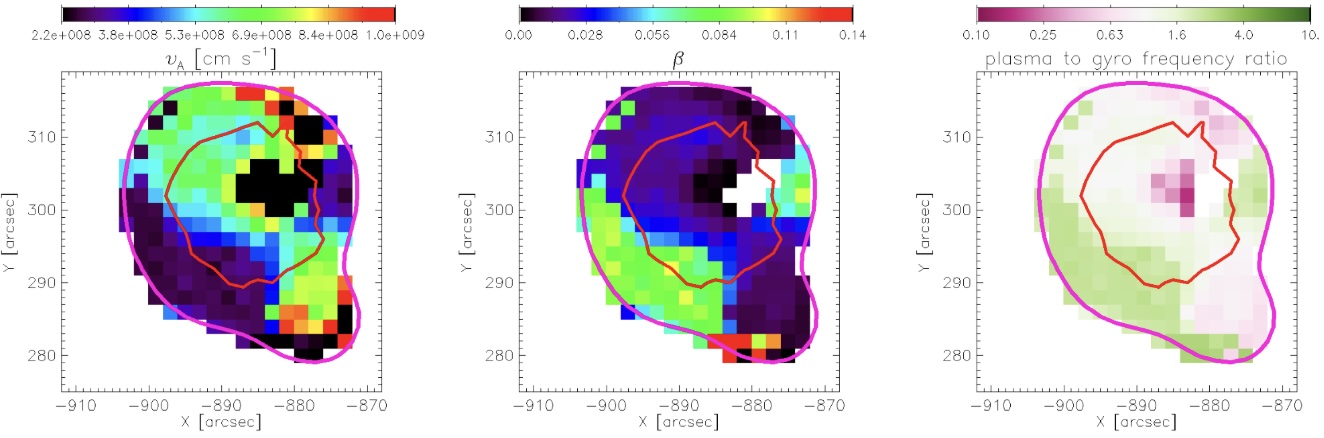
Fig. 2. Maps of the Alfvén speed, plasma beta, and the plasma-to-gyrofrequency ratio derived from the reconstructed flare parameters.
Based on the recent paper by T. Kaltman, S. Yu, G. D. Fleishman, and D. F. Ryan (2026), "Three-dimensional mapping of coronal magnetic field and plasma parameters in a solar flare," Astronomy & Astrophysics
Migrated from MediaWiki page OVSA Science Highlight No. 9: Inferring Alfvén Speed and Plasma Beta in 3D, latest revision 15277 (2026-05-01T16:00:45Z).