OVSA Science Highlight No. 13
Microwave Eyes on a Failed Solar Eruption
EOVSA imaged two coherent microwave bursts from energetic electrons near the front of a rising magnetic flux rope. Together with multiwavelength observations, the radio sources support a picture in which external reconnection eroded the rope while strong overlying fields confined it, halting the eruption despite an M9.4 flare.
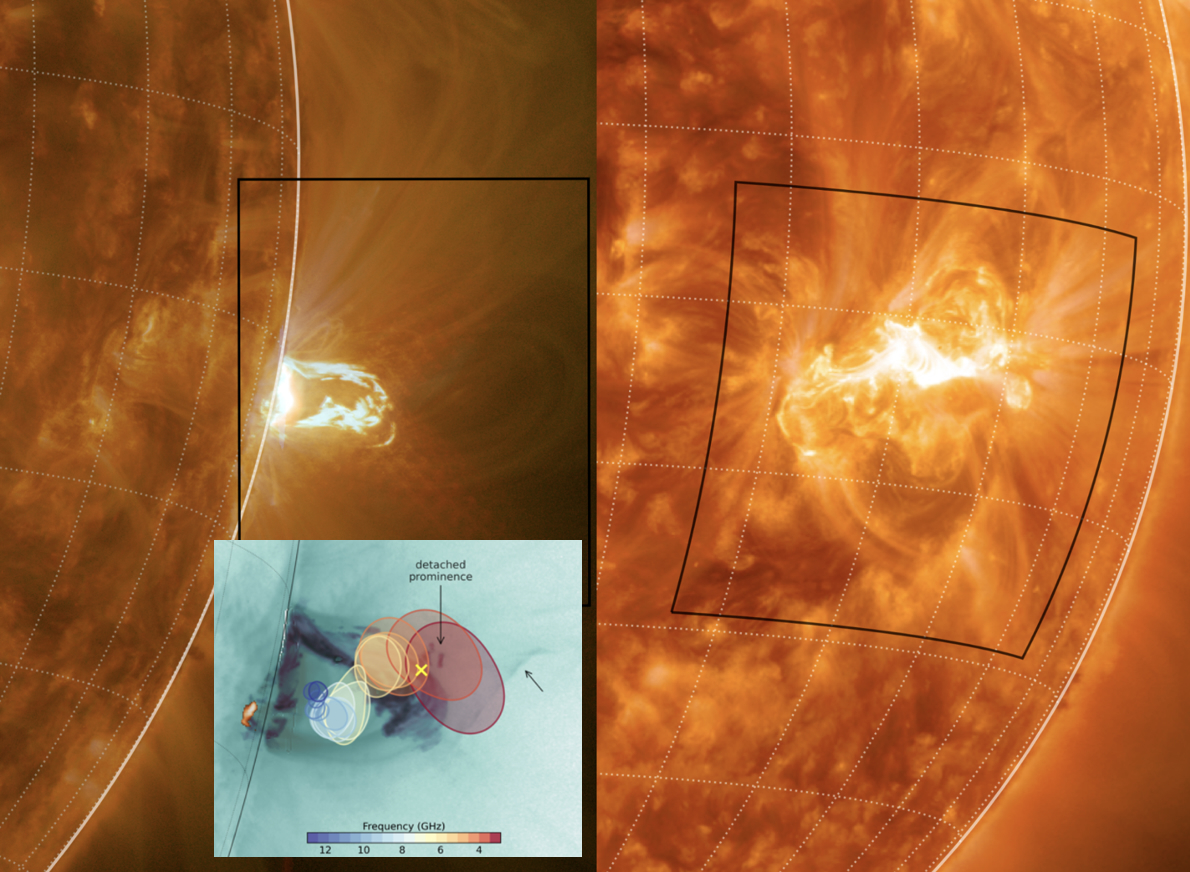
Multi-view observations of the failed 2024 March 30 solar eruption, with frequency-coded EOVSA microwave sources overlaid near the detached prominence. Credit: Tingyu Gou; EOVSA/NJIT. Source: NJIT News.
Powerful flares do not always produce coronal mass ejections (CMEs). On 2024 March 30, a prominence and its hot magnetic flux rope rose above the Sun's west limb, then decelerated. Much of the prominence material fell back. No coherent CME associated with the flare was identified, although a diffuse white-light front dissipated in the outer corona.
Gou and colleagues combined EOVSA microwave imaging spectroscopy with ultraviolet, extreme-ultraviolet, X-ray, and spectroscopic observations from SDO, Solar Orbiter, Hinode, and IRIS. Earth and Solar Orbiter viewed the event from directions separated by about 44° in longitude, revealing both the off-limb dynamics and the on-disk magnetic setting. Together, the observations traced two spatially distinct reconnection sites: standard flare reconnection below the rope and external reconnection above and involving the rope, near a modeled coronal X-point.
EOVSA traces reconnection above the rising rope
EOVSA provided a key diagnostic of energetic electrons at the upper site. Around 21:13 UT, it detected two brief coherent bursts spanning roughly 2–6 GHz, with emission drifting from lower to higher frequencies. This drift is consistent with accelerated electrons propagating into regions of higher plasma density or magnetic field strength. Imaging placed the radio sources near the front of the rising rope and detached prominence, spatially separate from the flare's gyrosynchrotron continuum below. Combined with hot cusp-shaped outflows, remote footpoint brightening, and the displacement of prominence material, these timing and spatial relationships provide strong evidence for external reconnection involving the rope (Figure 1).
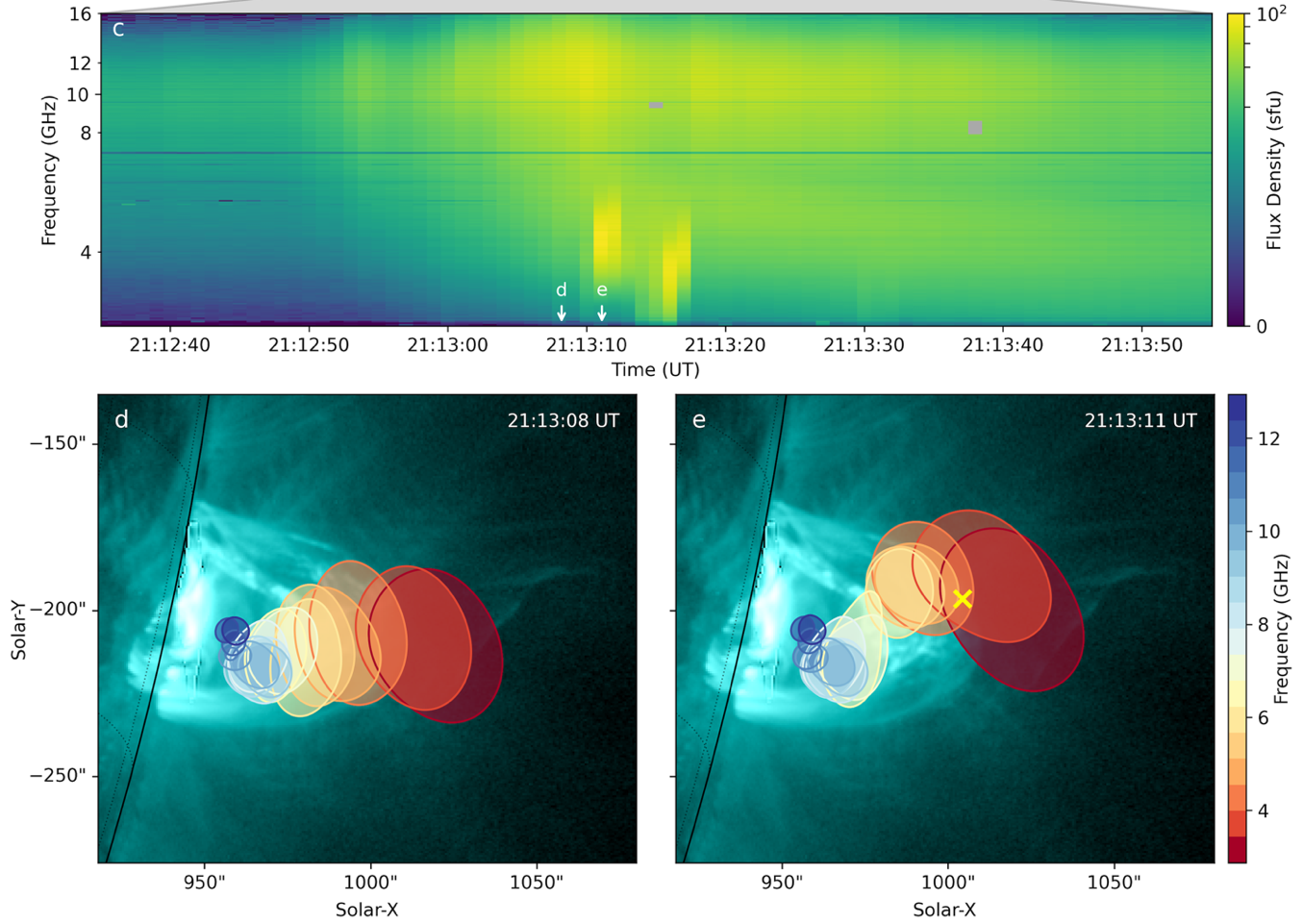
Figure 1. EOVSA microwave spectrum and images around 21:13 UT. Two short-lived 2–6 GHz bursts rapidly drift toward higher frequencies (top). Frequency-dependent sources (bottom) appear near the rising rope front and in the vicinity of the modeled coronal null (yellow cross), separate from the main flare gyrosynchrotron emission. From Gou et al. (2026), Extended Data Fig. 5c–e.
Why the eruption failed
The two reconnection sites affected the eruption in contrasting ways. Flare reconnection below the rope supplied poloidal flux and supported its acceleration. External reconnection involving the rope itself instead removed or rearranged rope flux, reducing the upward hoop force; its onset coincided with a sharp decrease in the rope's velocity. Strong overlying fields provided additional confinement: the rope stalled at about 140 Mm, below the roughly 180-Mm critical height inferred from the decay-index profile. Although the amount of removed flux could not be measured directly, the timing, imaging, spectroscopy, and kinematics support magnetic erosion as an important contributor to the failed eruption (Figure 2).
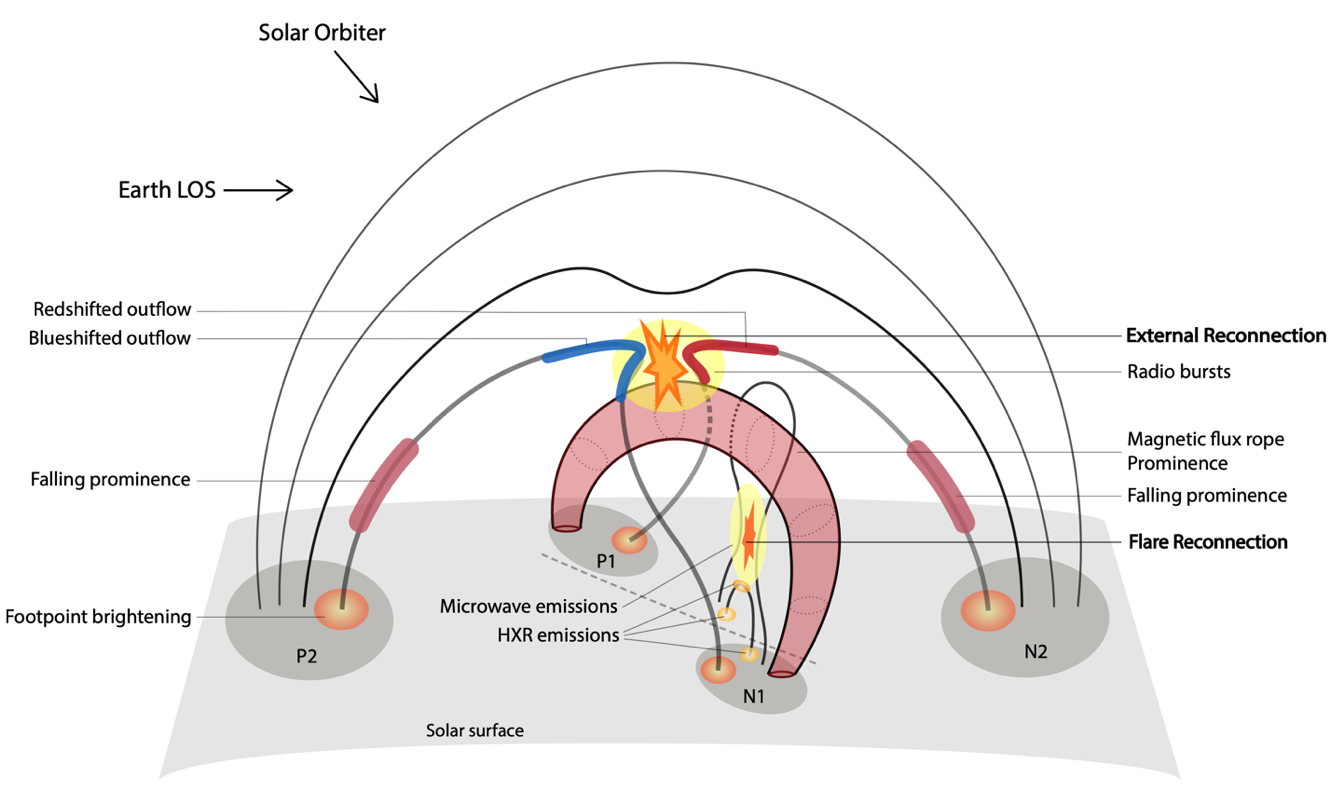
Figure 2. Schematic of the failed eruption in a multipolar magnetic topology. Flare reconnection below the rope and external reconnection above it act at distinct sites. The upper site is associated with radio bursts, outflows, remote footpoint brightening, and the redistribution of prominence material; microwave sources are shown in yellow. The schematic is not to scale. From Gou et al. (2026), Fig. 6.
This event shows that reconnection can either accelerate or weaken an eruption, depending on where it acts. EOVSA microwave imaging provides a way to identify energetic-particle signatures of otherwise difficult-to-observe reconnection around an erupting rope. Whether this erosion mechanism commonly helps confine solar eruptions, and how it relates to the scarcity of stellar CMEs, remain open questions.
Source study: Gou et al., Nature Astronomy (2026); arXiv:2604.23084