OVSA Science Highlight No. 11: Watching Magnetic Energy Drain from a Solar Flare
Contributed by Gregory D. Fleishman1 (1Center for Solar-Terrestrial Research, New Jersey Institute of Technology, Newark, NJ 07102, USA); Edited by S. Yu Posted on [May 11, 2026].
Solar flares are powered by magnetic energy stored in the Sun's corona. The challenge is that the coronal magnetic field is hard to measure while a flare is unfolding, especially inside the compact regions where particles are being accelerated. The Expanded Owens Valley Solar Array (EOVSA) provides one of the few ways to make such measurements directly, because microwave emission from flare-accelerated electrons carries information about both the energetic particles and the magnetic field through which they move.
A recent Astrophysical Journal paper reports EOVSA observations of the 2022 October 2 X1.1-class flare, an eruptive event seen on the solar disk. By fitting spatially resolved microwave spectra across the flare source, the authors mapped the coronal magnetic field and tracked its evolution during the rise of the event. The strongest changes occurred in several above-the-looptop locations, where the inferred field strength decayed rapidly, in some locations by up to about 10 Gauss per second (Fig. 1.)
The magnetic-field decay occurs where the nonthermal electron density rises, showing a close spatial and temporal connection between the weakening field and electron acceleration. EOVSA also measured the field in the loop legs and near the bottom of the erupting filament, giving a broader view of the evolving flare magnetic structure.
These measurements confirm and extend earlier EOVSA results from the famous 2017 September 10 X-class limb flare. The new event shows that rapid coronal magnetic-field decay is not restricted to one special geometry: it can also be observed in a disk flare with a different viewing angle. The released magnetic energy is sufficient to account for major components of the flare energy budget, strengthening the case that microwave imaging spectroscopy can locate where magnetic energy is converted into accelerated particles and plasma heating in solar eruptions.
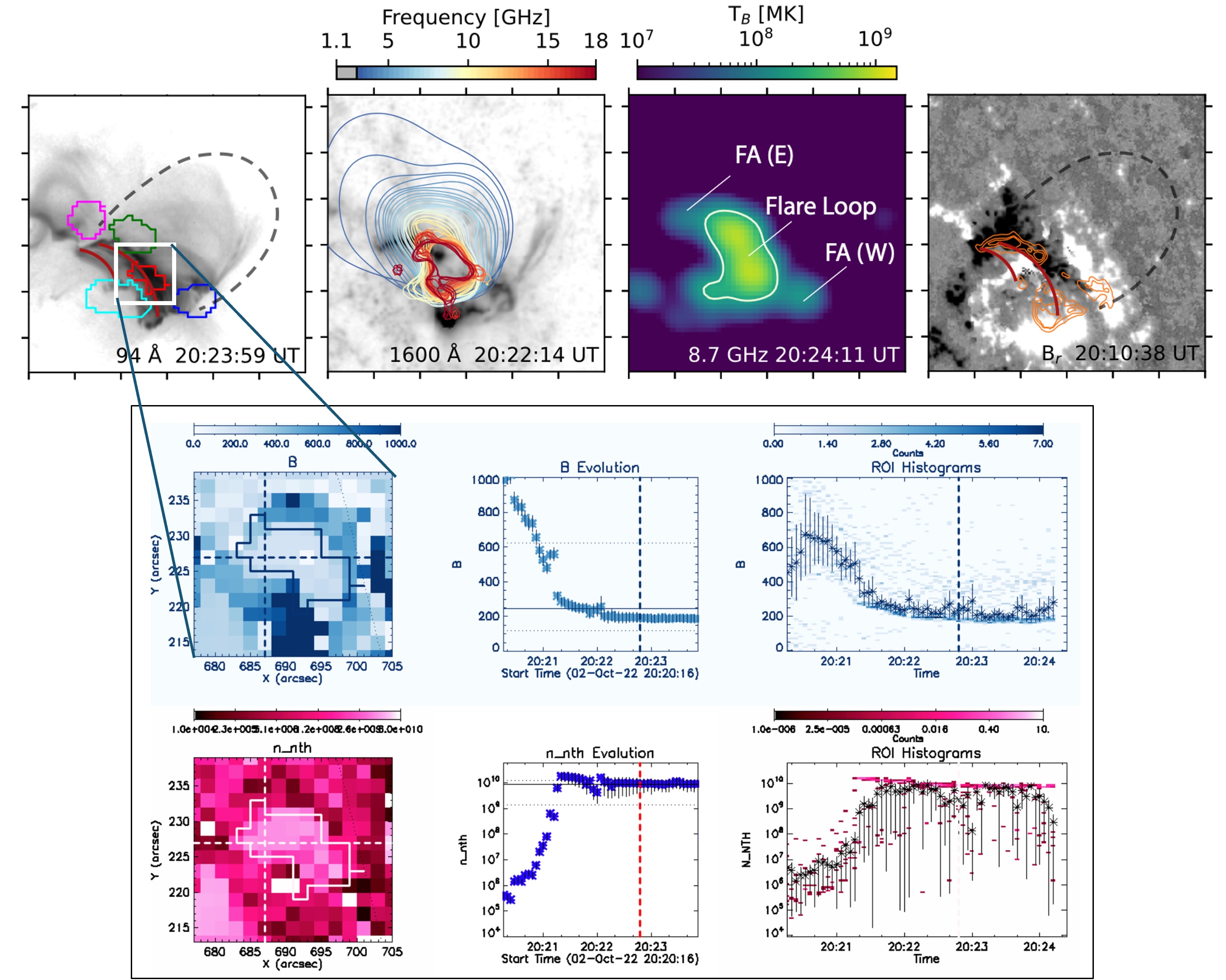
Fig. 1. SDO/AIA, SDO/HMI, and EOVSA observations of the 2022 October 2 X1.1 flare, together with EOVSA microwave spectral diagnostics in the southern looptop region. The top row shows, from left to right, an AIA 94 Å image of the hot flare arcade with analysis regions, an AIA 1600 Å image overlaid with multi-frequency EOVSA contours, an EOVSA 8.7 GHz brightness-temperature image identifying the flare-arcade sources and flare-loop source, and an HMI radial magnetic-field map showing the magnetic context and erupting filament. The lower panels zoom in on the southern looptop ROI marked in the AIA 94 Å image. In the left column, EOVSA-derived maps show the coronal magnetic field strength, B, at the top and the nonthermal electron density, n_nth, at the bottom; the polygon outlines the ROI and the dashed cross marks the representative pixel used for the time profiles. The middle column shows the temporal evolution of B and n_nth in that pixel, with vertical dashed lines marking the time of the displayed maps. The right column shows evolving 2D histograms of B and n_nth within the ROI, with black symbols and error bars indicating median values. The magnetic field shows a rapid initial decay followed by a slower decline toward an asymptotic level, while the nonthermal electron density rises at the same location.
Based on the recent paper by Gregory D. Fleishman, Tatyana Kaltman, and Sijie Yu (2026), "Dynamics of the Coronal Magnetic Field in the 2022 October 2 X-class Flare," The Astrophysical Journal, 999, 179
References
- Fleishman, G. D., Gary, D. E., Chen, B., Kuroda, N., Yu, S., and Nita, G. M. (2020), "Decay of the Coronal Magnetic Field Can Release Sufficient Energy to Power a Solar Flare," Science, 367, 278-280.
- Fleishman, G. D., Nita, G. M., Chen, B., Yu, S., and Gary, D. E. (2022), "Solar flare accelerates nearly all electrons in a large coronal volume," Nature, 606, 674-677.
Migrated from MediaWiki page OVSA Science Highlight No. 11: Watching Magnetic Energy Drain from a Solar Flare, latest revision 15420 (2026-05-11T20:42:15Z).